Showing posts with label mineral. Show all posts

Friday, March 24, 2017

30+ Thin Section Photos That Will Develop Your Interest in Petrography

 A “thin section” of rock is a sample that is mounted to a microscope slide and cut so thin that you can see light through it. The process of creating a thin section is a blend of artistry, technology and science.  
The art of preparing thin sections has been critical to understanding the core samples that scientists are observing. Thin section samples allow scientists to observe minerals in rocks, their crystal structure and texture at a microscopic level.

Want to revise how do geologists study rock? Follow this link to see our blog on "Studying Rock".

In this blog, we're taking you into the journey of thin section photos that were captured and given by students and young professionals from Finland, Ireland, Denmark, Czech Republic and Plymouth (UK). 


Again our purpose is to encourage students and professionals' research by promoting "learning and scope" of Geology through our blogs. Help us to help others in learning and understanding geology. See this link that how you can contribute to Learning Geology.


Note: We are using following thin section photos by having permission from their owners. If 
you like to use these photos, leave us a message or email us here.

1. A beautiful heart shaped hornblende in XPL (cross polarized light) view.It is a thin section of basalt with some secondary mineralization in the vesicles. Plagioclase is present in the form of black and white matrix and large phenocryst (with some zoning). Alignment of plagioclase grains is indicative of the "flow" of magma.

Photo Credits: Astaley

2. Thin Section of a Biotite and Muscovite, XPL view 

Photo Courtesy: Laura

3. Thin Section of a Plagioclase (orthoclase) and Pyroxene, XPL 

Photo Courtesy: Laura


4. Eclogite in Thin Section, XPL

Photo Courtesy: Laura

 5. Cummulate Rock with Pyroxene and plagioclase, XPL

Photo Courtesy: Laura

6. Blueschist, XPL

Photo Courtesy: Laura

7. Agglomerate in a Thin Section, XPL view

  
     Agglomerates are pyroclastic igneous rocks that consist almost wholly of angular or rounded lava fragments of varying size and shape. Fragments are usually poorly sorted in a tuffaceous matrix, or appear in lithified volcanic ash. (Britannica.com)

Photo Courtesy: Laura
8. Thin Section of a Pigeonite and Olivine, XPL

Photo Courtesy: Laura

9. Olivine phenocryst in Basaltic Lapilli, XPL

Photo Courtesy: Laura

10. Thin Section of a Gabbro, XPL

Showing minerals; Pyroxene and Olivine, plagioclase and others. Learn more about Gabbro here.


Photo Courtesy: Laura

 11. Another beautiful thin section of a Gabbro, XPL

Photo Courtesy: Laura
12. Thin Section of a Greenschist, XPL

Photo Courtesy: Laura

13. Thin Section showing intrusion of rocks from magma chamber into country rocks, XPL

Photo Courtesy: Jack Lewis Donnelly


14. Thin Section of a Sillimanite - a mineral found in rocks formed by the metamorphism of a mudstone. (XPL view)

Photo Courtesy: Jack Lewis Donnelly
15. Microgeode in ultrabasic vulcanite (
a rare copper telluride mineral), 30 µm thin section, PPL and XPL 

Photo Courtesy: Petr Hyks

Photo Courtesy: Petr Hyks
                                                              See original photo here

16. Muscovite & biotite (30 µm thin section, PPL and XPL)


Photo Courtesy: Petr Hyks


Photo Courtesy: Petr Hyks
Same photo in XPL view. See original photo here

17. Quartz and epidote (30 µm thin section, PPL and XPL)

Photo Courtesy: Petr Hyks

Photo Courtesy: Petr Hyks
                                                        See original here.

18. Olivine (30 µm thin section, PPL and XPL)

Photo Courtesy: Petr Hyks
See this photo here on Petr Hyks' website

19. Zircons in biotite (30 µm thin section, PPL views, showing extinction)
                                                                                         
                                                                                  
                          Photo Courtesy: Petr Hyks
                              See this photo here on Petr's website


20. Zircon in biotite (30 µm thin section, XPL)

Photo Courtesy: Petr Hyks
See this photo here on Petr's website

21. Kyanite surrounded by muscovite (30 µm thin section, PPL and XPL)

Photo Courtesy: Petr Hyks
See these photos on Petr's page here and here

22. Zircon crystal in chloritized biotite (30 µm thin section, PPL and XPL)


Photo Courtesy: Petr Hyks
See these photos on Petr's page  here and here
Petr Hyks is 21 year old geology student from Masaryk University in Brno (Czech Republic). He has uploaded 5000+ photos about geology, astronomy and meteorology on his Flickr page. Follow this link to visit his website. Thank you Petr for contributing to Learning Geology and helping others to learn geology through your thin section photos. 🙂 Now following 10 thin section photos are from a geology student of University of Helsinki, Finland.

23. Thin Section of Olivine Diabase in XPL and PPL view.

Photo Courtesy: GeoAmethyst

24. Thin Section of Basalt in XPL view
        Having minerals: Olivine (in center) plagioclase, pyroxene and other accessory minerals
Photo Courtesy: GeoAmethyst

25. Thin Section of a Trachyte, XPL view

    Trachyte is an igneous volcanic rock with aphanitic to porphyritic texture. It is volcanic equivalent of Syenite. Major or essential minerals are alkali feldspar with less amount of plagioclase, quartz or feldspathiod. 

Photo Courtesy: GeoAmethyst


26. Thin Section of a Harzburgite, XPL view
      Harzburgite is an ultramafic igneous rock. It chiefly contains plagioclase (under 10%) , olivine, orthopyroxene (enstatite), clinopyroxene (diopside) and biotite. There could be a small amount of talc, carbonate, tremolite, cummingtonite, chlorite, serpentine and titanite.
Photo Courtesy: GeoAmethyst

27.  Another thin section of Harzburgite, XPL view

Photo Courtesy: GeoAmethyst

28.  Thin Section of Pyroxenite (an ultramafic igneous rock), XPL view

Photo Courtesy: GeoAmethyst

29. Thin Section of Trachyte showing Sandine mineral in center, XPL view

Photo Courtesy: GeoAmethyst
 
30.  Thin Section of Andesite, XPL view
       It is an extrusive igneous, of intermediate composition, with aphanitic to porphyritic texture.              Here this thin section is showing chiefly hornblende and plagioclase.
Photo Courtesy: GeoAmethyst

31. Thin Section of Alkali Basalt (silica undersaturated) in XPL view.

Photo Courtesy: GeoAmethyst


32. Thin Section showing small clinopyroxene grains within orthopyroxene

Photo Courtesy: GeoAmethyst

Like this article? Leave a comment down or send us your valuable suggestion or feedback here  to help us in improving this article.
Useful Websites: 

1. Polarized light Microscopy (Image Gallery)
2. How to make a thin section
3. Petrographic thin section preparation
4. Guide to Thin Section Microscopy
5. Index of Minerals in Thin Section
6.
Optical Petrography website by an Italian Geologist

7. Carbonate Thin Section Images and 
Exercises

Saturday, December 10, 2016

Copper

What is Copper?

Copper is a chemical element with symbol Cu (from Latin: cuprum) and atomic number 29. It is a soft, malleable and ductile metal with very high thermal and electrical conductivity. A freshly exposed surface of pure copper has a reddish-orange colour. It is used as a conductor of heat and electricity, as a building material and as a constituent of various metal alloys, such as sterling silver used in jewellery, cupronickel used to make marine hardware and coins and constantan used in strain gauges and thermocouples for temperature measurement.
Copper is found as a pure metal in nature, and this was the first source of the metal to be used by humans, c. 8000 BC. It was the first metal to be smelted from its ore, c. 5000 BC, the first metal to be cast into a shape in a mold, c. 4000 BC and the first metal to be purposefully alloyed with another metal, tin, to create bronze, c. 3,500 BC.
In the Roman era, copper was principally mined on Cyprus, the origin of the name of the metal, from aes сyprium (metal of Cyprus), later corrupted to сuprum, from which the words copper (English), cuivre (French), Koper (Dutch) and Kupfer (German) are all derived. The commonly encountered compounds are copper(II) salts, which often impart blue or green colours to such minerals as azurite, malachite, and turquoise, and have been used widely and historically as pigments. Architectural structures built with copper (usually roofing elements) corrode to give green verdigris (or patina). Decorative art prominently features copper, both in the elemental metal and in compounds as pigments. Copper compounds are also used as bacteriostatic agents, fungicides, and wood preservatives.
Copper is essential to all living organisms as a trace dietary mineral because it is a key constituent of the respiratory enzyme complex cytochrome c oxidase. In molluscs and crustaceans copper is a constituent of the blood pigment hemocyanin, replaced by the iron-complex haemoglobin in fish and other vertebrates. In humans, copper is found mainly in the liver, muscle, and bone. The adult body contains between 1.4 and 2.1 mg of copper per kilogram of body weight. Hence a healthy human weighing 60 kilogram contains approximately 0.1 g of copper. However, this small amount is essential to the overall human well-being.

Characteristics

Physical

Copper, silver and gold are in group 11 of the periodic table, and they share certain attributes: they have one s-orbital electron on top of a filled d-electron shell and are characterised by high ductility and electrical and thermal conductivity. The filled d-shells in these elements contribute little to interatomic interactions, which are dominated by the s-electrons through metallic bonds. Unlike metals with incomplete d-shells, metallic bonds in copper are lacking a covalent character and are relatively weak. This observation explains the low hardness and high ductility of single crystals of copper. At the macroscopic scale, introduction of extended defects to the crystal lattice, such as grain boundaries, hinders flow of the material under applied stress, thereby increasing its hardness. For this reason, copper is usually supplied in a fine-grained polycrystalline form, which has greater strength than monocrystalline forms.
The softness of copper partly explains its high electrical conductivity (59.6×10⁶ S/m) and high thermal conductivity, the second highest (second only to silver) among pure metals at room temperature. This is because the resistivity to electron transport in metals at room temperature originates primarily from scattering of electrons on thermal vibrations of the lattice, which are relatively weak in a soft metal. The maximum permissible current density of copper in open air is approximately 3.1×10⁶ A/m2 of cross-sectional area, above which it begins to heat excessively.
Copper is one of four metallic elements with a natural colour other than gray or silver, the others being caesium (yellow), gold (yellow), and osmium (bluish). Pure copper is orange-red and acquires a reddish tarnish when exposed to air. The characteristic colour of copper results from the electronic transitions between the filled 3d and half-empty 4s atomic shells – the energy difference between these shells corresponds to orange light. The same mechanism causes the yellow colour of gold and caesium.
As with other metals, if copper is put in contact with another metal, galvanic corrosion will occur.

Chemical

Copper does not react with water but it does slowly react with atmospheric oxygen to form a layer of brown-black copper oxide which, unlike the rust that forms on iron in moist air, protects the underlying metal from further corrosion (passivation). A green layer of verdigris (copper carbonate) can often be seen on old copper structures, such as the roofing of many older buildings and the Statue of Liberty. Copper tarnishes when exposed to some sulphur compounds, with which it reacts to form various copper sulphides.

Isotopes

There are 29 isotopes of copper. 63Cu and 65Cu are stable, with 63Cu comprising approximately 69% of naturally occurring copper; both have a spin of  3⁄2. The other isotopes are radioactive, with the most stable being 67Cu with a half-life of 61.83 hours.Seven metastable isotopes have been characterised; 68Cu is the longest-lived with a half-life of 3.8 minutes. Isotopes with a mass number above 64 decay by β−, whereas those with a mass number below 64 decay by β+. 64Cu, which has a half-life of 12.7 hours, decays both ways.
62Cu and 64Cu have significant applications. 62Cu is used in 62Cu-PTSM as a radioactive tracer for positron emission tomography.

Occurrence

Copper is produced in massive stars and is present in the Earth's crust in a proportion of about 50 parts per million (ppm). It occurs as native copper, in the copper sulphides chalcopyrite and chalcocite, in the copper carbonates azurite and malachite, and in the copper(I) oxide mineral cuprite. The largest mass of elemental copper discovered weighed 420 tonnes and was found in 1857 on the Keweenaw Peninsula in Michigan, US. Native copper is a polycrystal, with the largest single crystal ever described measuring 4.4×3.2×3.2 cm.

Physical Properties

Chemical FormulaCu
ColourMetallic, Red, Orange, Brown
Hardness2.5 - 3
Crystal SystemIsometric
SG8.9
TransparencyOpaque
Double RefractionNone
LusterMetallic
CleavageNone
Mineral ClassCopper

Friday, February 26, 2016

Mineral Classification

Mineral Classification 

The 4,000 known minerals can be separated into a small number of groups, or mineral classes. You may think, “Why bother?” Classification schemes are useful because they help organize information and streamline discussion. Biologists, for example, classify animals into groups based on how they feed their young and on the architecture of their skeletons, and botanists classify plants according to the way they reproduce and by the shape of their leaves. In the case of minerals, a good means of classification eluded researchers until it became possible to determine the chemical makeup of minerals. A Swedish chemist, Baron Jöns Jacob Berzelius (1779–1848), analyzed minerals and noted chemical similarities among many of them. Berzelius, along with his students, established that most minerals can be classified by specifying the principal anion (negative ion) or anionic group (negative molecule) within the mineral. We now take a look at principal mineral classes, focusing especially on silicates, the class that constitutes most of the rock in the Earth.

Saturday, February 20, 2016

How Can You Tell One Mineral From Another?

How Can You Tell One Mineral From Another? 

Amateur and professional mineralogists get a kick out of recognizing minerals. They might hover around a display case in a museum and name specimens without bothering to look at the labels. How do they do it? The trick lies in learning to recognize the basic physical properties (visual and material characteristics) that distinguish one mineral from another. Some physical properties, such as shape and colour, can be seen from a distance. Others, such as hardness and magnetization, can be determined only by handling the specimen or by performing an identification test on it. Identification tests include scratching the mineral by another object, placing it near a magnet, weighing it, tasting it, or placing a drop of acid on it. Let’s examine some of the physical properties most commonly used in basic mineral identification.

Saturday, September 26, 2015

10 World's most deadly minerals

World's most deadly minerals

World's most deadly minerals that are valuable make the present day world go 'round. They're utilized as a part of everything from circuit sheets to tableware. They're likewise the absolute most poisonous materials known not, and unearthing them has demonstrated so perilous throughout the years, some have been eliminated of mechanical generation inside and out. Recorded beneath are the 10 most savage minerals on earth. These stones don't should be tossed to hurt you.

Chalcanthite


Chalcanthite (hydrated copper sulphate) is the brilliant blue mineral developed from arrangement in science labs and home substance packs. Chalcanthite ought to never be taste tried by beginner researchers for salt substance, or a to a great degree genuine overdose of copper could come about. Simply discharging gems of the blue mineral has murdered whole lakes of green growth, and postured extraordinary ecological dangers. . It is water solvent and will take shape out again from arrangement. The copper in this mineral is exceptionally bio-accessible and is lethal to plants and in high amounts dangerous to people.

Hutchinsonite 


Hutchinsonite is a sulfosalt mineral of thallium, arsenic and lead with recipe (Tl,Pb)2As5S9. Hutchinsonite is an unsafe however emotional blend of thallium, lead and arsenic. Is an uncommon sulphosalt mineral that obliges taking care of with extraordinary consideration as every one of the three of its fundamental segments are toxic especially thallium as it can bring about male pattern baldness, genuine ailment and passing. The three toxic metals shape a deadly mineral mixed drink that ought to be taken care of just with incredible alert.

Galena


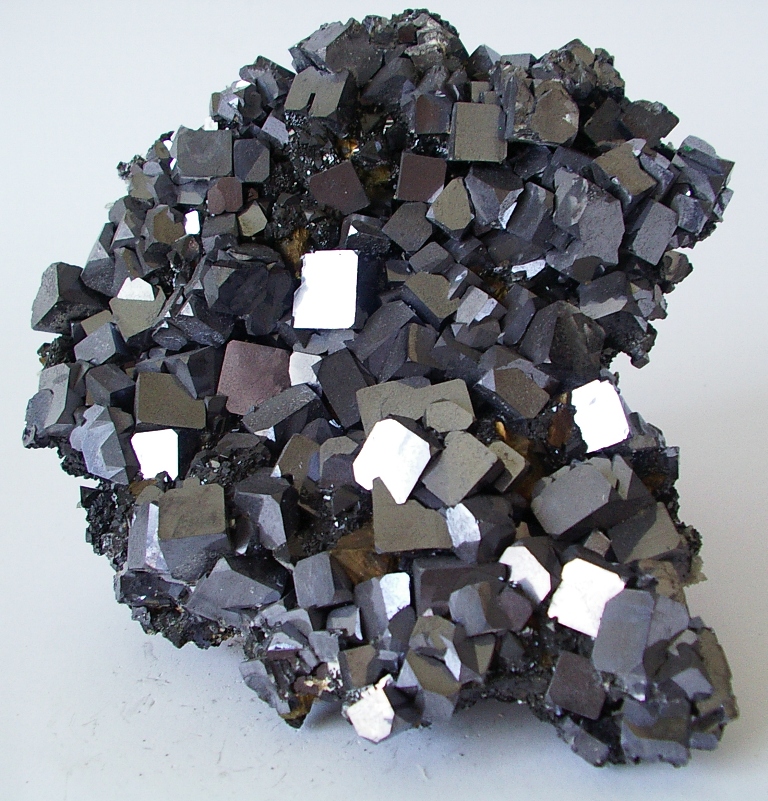
Galena is a stand out amongst the most bounteous and generally appropriated sulphide minerals. Galena is the standard metal of lead, and structures sparkling silver 3D squares with unnaturally flawless shapes. In spite of the fact that lead is ordinarily greatly adaptable, the sulphur substance of galena makes it phenomenally weak and receptive to compound treatment. It's not as awful as mercury, which will execute you promptly through and through, however lead doesn't get flushed out of your framework. It aggregates throughout the years, in the long run coming to harmful levels. When that happens both you and your children pay the cost, as lead danger is cancer-causing to you and is teratogenic (creating extreme conception deformities) to you're posterity.

Asbestos


Asbestos is not one mineral but rather six characterized separate minerals. One being a serpentine (chrysotile) and the other five being amphiboles (crocidolite, grunerite (amosite), tremolite, anthophyllite and actinolite). Dissimilar to alternate minerals in the main 10 deadliest. It was once broadly utilized for an assortment of business and mechanical applications on account of its solid, fireproof, and adaptable nature from roof tiles and roofing materials to ground surface and warm protection.

Torbernite


Torbernite is the mineral from hell fire. The crystal moulded green gems structure as auxiliary stores in granitic shakes, and are made out of uranium. Framed through a mind boggling response between phosphorous, copper, water and uranium, the shocking gem showcases have allured numerous mineral authorities into taking an example for a rack accumulation. The mineral is radioactive and emanates the disease shaping radon gas. This is one mineral you don't need on your showcase bureau rack.

Erionite 


Erionite (NaK2MgCa1.5)[Al8Si28]O72 28H2O) is an actually happening stringy mineral that fits in with a gathering of minerals called zeolites. It for the most part is found in volcanic fiery remains that has been modified by weathering and ground water. It looks a considerable measure like asbestos minerals and damages people much in the same way: mesothelioma. It's essentially an industry-particular infection or if nothing else it was, until we understood that it created super-malignancy and quit mining the stuff in the late 1980.

Cinnabar


Cinnabar (mercury sulphide - HgS) is the absolute most harmful mineral to handle on earth. It is the world's fundamental wellspring of mercury and has been mined subsequent to Neolithic times. In any case, when oxidized, this component will create methyl mercury and dimethyl mercury, two dangerous intensifies that cause un-salvageable damage to the sensory systems of kids. It is dangerous in little fixations and can be consumed through the respiratory tract, entrails, or skin. Much all the more unfathomably, some antiquated medicinal experts trusted cinnabar held recuperating powers, and recommended it for specific conditions.

Phenacite 


Phenacite is a genuinely uncommon nesosilicate mineral comprising of beryllium orthosilicate, Be2SiO4. Phenacite is mined both as a gemstone and for its important beryllium content. Beryllium was at one time a forerunner for some fired materials, until individuals made sense of that breathing in Beryllium dust brought about berylliosis otherwise known as interminable beryllium sickness. It's similar to silicosis however a great deal more extreme furthermore unending. You don't recoup from CBD essentially by minimizing your beryllium presentation. When you have it, you have it forever. Fundamentally what happens is the lungs get to be easily affected to berrylium, which causes an unfavourably susceptible response wherein the lungs from little knobs called granulomas. These granulomas make breathing amazingly troublesome and can go ahead to affect illnesses like tuberculosis.

Stibnite


Stibnite is a sulphide mineral with the equation Sb2S3. Hence, the tremendous, sparkling metallic gems of this shaky compound were once designed into superb eating utensils. Be that as it may, the sword moulded precious stones bore the forces of death to the individuals who utilized them. Treatment of this metalloid mineral can bring about harming.

Hydroxyapatite 


Hydroxyapatite (Ca5(PO4)3(OH)2 is a normally happening mineral type of calcium apatite. The phosphorous in your greenery enclosure manure and fluoride in your faucet water likely originated from a stone like this, called Apatite. These phosphate minerals come in three mixed bags, each separately containing hoisted levels of OH, F, or Cl particles the Hydroxyapatite variant being a noteworthy segment of your tooth finish and the Fluorapatite form constituting what's dumped into metro water supplies to avert depressions. Keeping in mind having solid teeth and bones is something worth mining so as to be thankful for, presentation to Hydroxyapatite (either or handling it) will store those same minerals on your heart valves, viably petrifying them.