Saturday, January 28, 2017

Banded-iron formations (BIFs) - Evidence of Oxygen in Early Atmosphere

Our knowledge about the rise of oxygen gas in Earth’s atmosphere comes from multiple lines of evidence in the rock record, including the age and distribution of banded iron formations, the presence of microfossils in oceanic rocks, and the isotopes of sulfur.
However, this article is just focus on Banded Iron Formation.
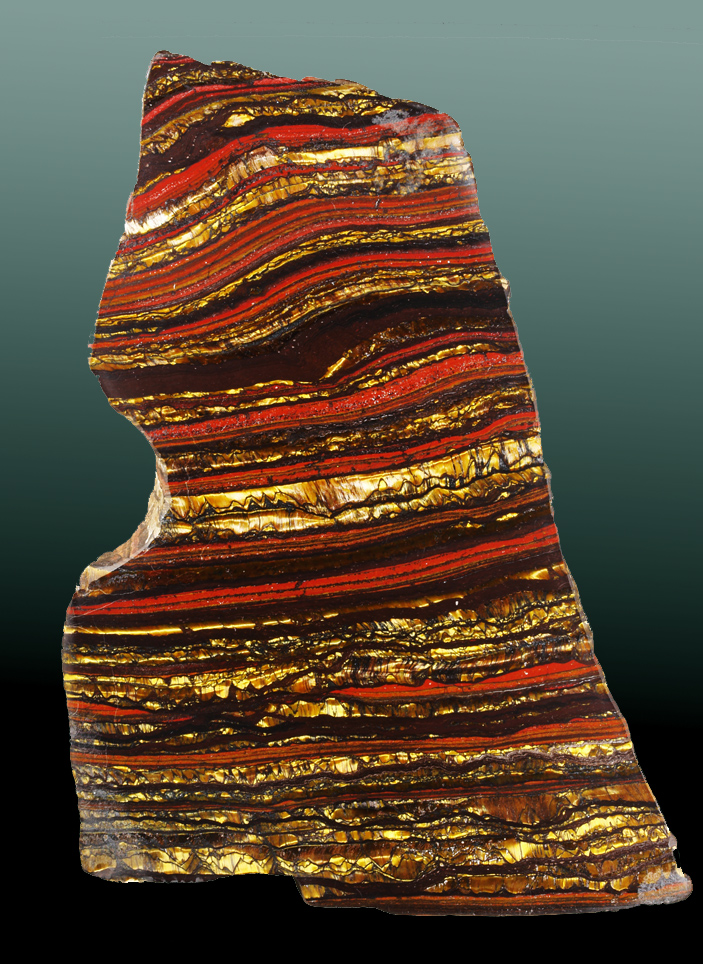
BIF (polished) from Hamersley Iron Formation, West Australia, Australia

Summary: Banded-iron formations (BIFs) are sedimentary mineral deposits consisting of alternating beds of iron-rich minerals (mostly hematite) and silica-rich layers (chert or quartz) formed about 3.0 to 1.8 billion years ago. Theory suggests BIFs are associated with the capture of oxygen released by photosynthetic processes by iron dissolved in ancient ocean water. Once nearly all the free iron was consumed in seawater, oxygen could gradually accumulate in the atmosphere, allowing an ozone layer to form. BIF deposits are extensive in many locations, occurring as deposits, hundreds to thousands of feet thick. During Precambrian time, BIF deposits probably extensively covered large parts of the global ocean basins. The BIFs we see today are only remnants of what were probably every extensive deposits. BIFs are the major source of the world's iron ore and are found preserved on all major continental shield regions. 

Banded-iron formation (BIF)
is 
consists of layers of iron oxides (typically either magnetite or hematite) separated by layers of chert (silica-rich sedimentary rock). Each layer is usually narrow (millimeters to few centimeters). The rock has a distinctively banded appearance because of differently colored lighter silica- and darker iron-rich layers. In some cases BIFs may contain siderite (carbonate iron-bearing mineral) or pyrite (sulfide) in place of iron oxides and instead of chert the rock may contain carbonaceous (rich in organic matter) shale.

It is a chemogenic sedimentary rock (material is believed to be chemically precipitated on the seafloor). Because of old age BIFs generally have been metamorphosed to a various degrees (especially older types), but the rock has largely retained its original appearance because its constituent minerals are fairly stable at higher temperatures and pressures. These rocks can be described as metasedimentary chemogenic rocks.


                     Jaspilite banded iron formation (Soudan Iron-Formation, Soudan, Minnesota, USA
Image Credits: James St. John


In the 1960s, Preston Cloud, a geology professor at the University of California, Santa Barbara, became interested in a particular kind of rock known as a Banded Iron Formation (or BIF). They provide an important source of iron for making automobiles, and provide evidence for the lack of oxygen gas on the early Earth.

Cloud realized that the widespread occurrence of BIFs meant that
the conditions needed to form them must have been common on the ancient Earth, and not common after 1.8 billion years ago. Shale and chert often form in ocean environments today, where sediments and silica-shelled microorganisms accumulate gradually on the seafloor and eventually turn into rock. But iron is less common in younger oceanic sedimentary rocks. This is partly because there are only a few sources of iron available to the ocean: isolated volcanic vents in the deep ocean and material weathered from continental rocks and carried to sea by rivers.


Banded iron-formation (10 cm), Northern Cape, South Africa.
Specimen and photograph: A. Fraser
Most importantly, it is difficult to transport iron very far from these sources today because when iron reacts with oxygen gas, it becomes insoluble (it cannot be dissolved in water) and forms a solidparticle. Cloud understood that for large deposits of iron to exist all over the world’s oceans, the iron must have existed in a dissolved form. This way, it could be transported long distances in seawater from its sources to the locations where BIFs formed. This would be possible only if there were little or no oxygen gas in the atmosphere and ocean at the time the BIFs were being deposited. Cloud recognized that since BIFs could not form in the presence of oxygen, the end of BIF deposition probably marked the first occurrence of abundant oxygen gas on Earth (Cloud, 1968).
Cloud further reasoned that, for dissolved iron to finally precipitate and be deposited, the iron would have had to react with small amounts of oxygen near the deposits. Small amounts of oxygen could have been produced by the first photosynthetic bacteria living in the open ocean. When the dissolved iron encountered the oxygen produced by the photosynthesizing bacteria, the iron would have precipitated out of seawater in the form of minerals that make up the iron-rich layers of BIFs: hematite (Fe2O3) and magnetite (Fe3O4), according to the following reactions:
4Fe3 + 2O2 → 2Fe2O3
6Fe2 + 4O2 → 2Fe3O4
The picture that emerged from Cloud’s studies of BIFs was that small amounts of oxygen gas, produced by photosynthesis, allowed BIFs to begin forming more than 3 billion years ago. The abrupt disappearance of BIFs around 1.8 billion years ago probably marked the time when oxygen gas became too abundant to allow dissolved iron to be transported in the oceans.
Banded Iron Formation
Source is unknown

It is interesting to note that BIFs reappeared briefly in a few places around 700 millionyears ago,during a period of extreme glaciation when evidence suggests that Earth’s oceans were entirely covered with sea ice. This would have essentially prevented the oceans from interacting with the atmosphere, limiting the supply of oxygen gas in the water and again allowing dissolved iron to be transported throughout the oceans. When the sea ice melted, the presence of oxygen would have again allowed the iron to precipitate.

References:

1. Misra, K. (1999). Understanding Mineral Deposits Springer.
2. 
Cloud, P. E. (1968). Atmospheric and hydrospheric evolution on the primitive Earth both secular accretion and biological and geochemical processes have affected Earth’s volatile envelope. Science, 160(3829), 729–736.
3. 
James,H.L. (1983). Distribution of banded iron-formation in space and time. Developments in Precambrian Geology, 6, 471–490.

Friday, January 13, 2017

Pearl gemstone

What is Pearl Gemstone?

A pearl is a hard object produced within the soft tissue (specifically the mantle) of a living shelled mollusk. Just like the shell of a clam, a pearl is composed of calcium carbonate in minute crystalline form, which has been deposited in concentric layers. The ideal pearl is perfectly round and smooth, but many other shapes (baroque pearls) occur. The finest quality natural pearls have been highly valued as gemstones and objects of beauty for many centuries. Because of this, pearl has become a metaphor for something rare, fine, admirable and valuable.
The most valuable pearls occur spontaneously in the wild, but are extremely rare. These wild pearls are referred to as natural pearls. Cultured or farmed pearls from pearl oysters and freshwater mussels make up the majority of those currently sold. Imitation pearls are also widely sold in inexpensive jewellery, but the quality of their iridescence is usually very poor and is easily distinguished from that of genuine pearls. Pearls have been harvested and cultivated primarily for use in jewellery, but in the past were also used to adorn clothing. They have also been crushed and used in cosmetics, medicines and paint formulations.
Whether wild or cultured, gem-quality pearls are almost always nacreous and iridescent, like the interior of the shell that produces them. However, almost all species of shelled mollusks are capable of producing pearls (technically "calcareous concretions") of lesser shine or less spherical shape.

History and Introduction

Pearls are organic gemstones that are formed by shelled molluscs; mainly bivalved oysters and mussels. Pearls are made up of nacre (mother-of-pearl) which is mostly aragonite (calcium carbonate) and conchiolin (complex proteins that form mollusc shells). The aragonite microcrystals build up around an irritant. The name "pearl" is said to have originated from the Middle English word "perle", which in turn came from the Latin word "perna", meaning "leg", thought to be due to the ham-leg shape of the bivalve mollusc.
Natural pearls are extremely rare, incredibly expensive and typically small. Therefore people have developed ways to culture pearls, so that these beautiful gemstones can be enjoyed by many. In cultured pearls, some tissue or a mother-of-pearl bead is introduced into the mollusc shell. If successful, this process induces the animal to form a "pearl sac" whose cells secrete a layer of brownish protein called conchiolin over the irritant. This is followed by the secretion of numerous mineral layers of nacre composed of calcium carbonate in thin overlapping plates. Pearls can come from fresh or seawater molluscs. The beauty of pearls is that they can be plucked from the shell naturally beautiful, fully-formed and displaying perfect lustre with no need to be cut or polished.
The oldest recorded reference to pearls in history is the 7,500 year-old "Umm Al Quwain Pearl", which was found in a grave in a place that is now known as the UAE. Before pearls were cultured by man, they were harvested from the Persian Gulf, Sri Lankan waters, fresh water sources in China and the rivers of Europe. Later, Christopher Columbus discovered pearls in South America. When these natural pearls were almost depleted in the early twentieth century, the Chinese and Japanese began to culture pearls and the rest is history. Nowadays, pearls remain a treasured adornment and are cultured all around the world.

Physical properties

The unique luster of pearls depends upon the reflection, refraction, and diffraction of light from the translucent layers. The thinner and more numerous the layers in the pearl, the finer the luster. The iridescence that pearls display is caused by the overlapping of successive layers, which breaks up light falling on the surface. In addition, pearls (especially cultured freshwater pearls) can be dyed yellow, green, blue, brown, pink, purple, or black. The very best pearls have a metallic mirror-like luster.
Because pearls are made primarily of calcium carbonate, they can be dissolved in vinegar. Calcium carbonate is susceptible to even a weak acid solution because the crystals of calcium carbonate react with the acetic acid in the vinegar to form calcium acetate and carbon dioxide.

Identifying Pearl

Pearls can be identified by their pearly lustre and when rubbed gently against the teeth, a slightly rough surface texture can be detected, whereas imitation pearls feel smooth. The surface appearance of natural and cultured pearls is the same, but the density of cultured pearls is usually higher, at approximately 2.73 for most. The only definite way of distinguishing between natural and cultured pearls is to examine their internal structure. Experts use endoscopes to do this through the drill holes of pearls. Natural pearls have concentric internal layers.

Pearl: Origin and Gemstone Sources

Pearls are found and cultured in waters all over the world. Natural sea pearls are found in Australia, Japan, Central America, the Persian Gulf, the Gulf of Manaar (between India and Sri Lanka), the coast of Madagascar, Burma (Myanmar), the Philippines, the South Pacific Islands (including Tahiti and Fiji) and South America.
Natural river pearls are found in Asia, Europe and North America.
Cultured seawater pearl sources include Southeast Asia (such as Indonesia and the Philippines), Australia, China, French Polynesia, Japan, South Pacific Islands (including Tahiti and Fiji) and the Philippines.
Cultured freshwater pearl sources include China and Japan.
Basra pearls where basra moti in the Indian language, natural pearl gemstone which are found in the Indian Ocean are also called as basra pearls.

Freshwater and saltwater pearls

Freshwater and saltwater pearls may sometimes look quite similar, but they come from different sources.
Freshwater pearls form in various species of freshwater mussels, family Unionidae, which live in lakes, rivers, ponds and other bodies of fresh water. These freshwater pearl mussels occur not only in hotter climates, but also in colder more temperate areas such as Scotland (where they are protected under law). Most freshwater cultured pearls sold today come from China.
Saltwater pearls grow within pearl oysters, family Pteriidae, which live in oceans. Saltwater pearl oysters are usually cultivated in protected lagoons or volcanic atolls.

Determining Pearl Gemstone Value

Pearl Colour

Pearls are available in a variety of colours. Colours of pearls include the following: White, pink, silver, cream, golden, green, blue and black. Some pearls exhibit iridescence, which is known as orient.

Pearl Clarity and Lustre

The lustre of pearls depends on the quality of the nacre. Pearls should have the characteristic shiny pearly lustre and their surface should show sharp and bright reflections. The surfaces of good quality pearls are smooth and blemish-free with a suitable layer of nacre to increase durability.

Pearl Cut and Shape

Pearls can be round, oval, pear-shaped or misshapen (baroque pearls). However, the best materials are regularly shaped. The most valuable shapes are symmetrical spheres or symmetrical drops. Pearl sizes depend on the type of mollusc that they form in and they typically range from 2 mm to 16 mm in diameter.

Pearl Treatment

Pearls are often bleached to lighten and enhance their colour. In this way, a uniform colour can be achieved for beaded necklaces.

Metaphysical properties of Pearls

Pearls symbolise Purity, Spiritual Transformation, Charity, Honesty, Wisdom and Integrity, all the best within us. Pearls provide a clear vehicle for the advancing states of wisdom, as well as a clean channel for receipt of spiritual guidance.
Pearls can stimulate your femininity and help with self acceptance. They lift your spirits and make you feel calm and beautiful. They remind us to walk with Dignity.
Pearls not only provide a mirror in which to see ourselves, but give us insight into how we appear to others.
The ragged, rough grain of sand, transformed over time slowly growing into a object of great value and beauty. With it's humble beginnings, Pearls symbolise innocence and a pure heart, and help us get in touch with the simple honest things of life.
Pearl grants to its wearer extraordinary foresight, protects him from risky commercial transactions and from evil eye. Pearl's magical properties depend on its colour: white Pearl brings freedom, brownish - wisdom, yellowish - wealth, greenish - happiness.
Pearl signifies faith, charity and innocence. It enhances personal integrity and helps to provide a focus to ones attention. Pearl symbolises purity and is known as a “stone of sincerity”. It brings truth to situations and loyalty to a “cause”. Inhibits boisterous behaviour.

Healing properties of Pearls

Pearls have been used throughout medical history to help treat disorders of the digestive tract, muscular systems and the skin. Powders and potions containing pearls have also been developed to aid in fertility, as well as in easing the discomforts of the birthing process. Many cultures and societies have made similar claims for this lustrous gem.
The Chinese, for example, have depended on the healing properties of the pearl for centuries. They have used it to treat everything from simple eye ailments to serious heart problems, bleeding, fever and indigestion. To this day, the Chinese still use pearl powder as a skin whitener and a cosmetic, as do many other people around the world. In fact, the pearl is widely considered to be effective in controlling the skin conditions rosacea and acne.
Pearls are considered to be very effective in treating health issues related to the stomach, heart and spleen. It calms the mind and prevents hysteria, promoting mental stability.It was believed that Pearl boosts sexual energy, strengthens visual acuity and heals ears diseases. It is beneficial for heart, lungs (against tuberculosis, asthma, chronic bronchitis), kidneys, urinary system and liver. Pearl possesses sedative and also laxative effect, neutralises poison, lowers acidity, It relieves conditions of bloating and biliousness.
Pearl increases fertility and eases childbirth. Pearl also raises sensuality. Pearl was believed to be the main ingredient of "immortality elixir".

Properties of Pearl gemstone

ColourWhite, Blue, Green, Yellow, Orange, Brown, Pink, Purple, Gray, Black, Multicolored
Hardness2.5 - 4.5
Crystal SystemAmorphous
Refractive Index1.52 - 1.69
SG2.6 - 2.8
TransparencyOpaque
Double Refraction.156
LusterPearly
CleavageNone
Mineral ClassCalcium carbonate and conchiolin (organic) combined with water