Showing posts with label basin. Show all posts

Sunday, December 17, 2017

Basics of Basin Analysis


·         A sedimentary basin is an area in which sediments have accumulated during a particular time period at a significantly greater rate and to a significantly greater thickness than surrounding areas.

·         A low area on the Earth’s surface relative to surroundings e.g. deep ocean basin (5-10 km deep), intramontane basin (2-3 km a.s.l.)

·         Basins may be small (kms2) or large (106+ km2)

·         Basins may be simple or composite (sub-basins)

·         Basins may change in size & shape due to:
1.      erosion

2.      sedimentation
3.      tectonic activity
4.      eustatic sea-level changes
·         Basins may overlap each other in time

·         Controls on Basin Formation

1.      Accommodation Space,

a.       Space available for the accumulation of sediment
b.      T + E = S + W T=tectonic subsidence E= Eustatic sea level rise S=Rate of sedimentation W=increase in water depth
2.      Source of Sediment
a.       Topographic Controls
b.      Climate/Vegetation Controls
c.       Oceanographic Controls (Chemical/Biochemical Conditions)

·         The evolution of sedimentary basins may include:

1.      tectonic activity (initiation, termination)

2.      magmatic activity
3.      metamorphism
4.      as well as sedimentation
·         Axial elements of sedimentary basins:

1.      Basin axis is the lowest point on the basement surface

2.      Topographic axis is the lowest point on the depositional surface
3.      Depocentre is the point of thickest sediment accumulation

·         The driving mechanisms of subsidence are ultimately related to processes within the relatively rigid, cooled thermal boundary layer of the Earth known as the lithosphere. The lithosphere is composed of a number of tectonic plates that are in relative motion with one another. The relative motion produces deformation concentrated along plate boundaries which are of three basic types:

1.      Divergent boundaries form where new oceanic lithosphere is formed and plates diverge. These occur at the mid-ocean ridges.
2.      Convergent boundaries form where plates converge. One plate is usually subducted beneath the other at a convergent plate boundary. Convergent boundaries may be of different types, depending on the types of lithosphere involved. This result in a wide diversity of basin types formed at convergent boundaries.
3.      Transform boundaries form where plates move laterally past one another. These can be complex and are associated with a variety of basin types.

·         Many basins form at continental margins.
Using the plate tectonics paradigm, sedimentary basins have been classified principally in terms of the type of lithospheric substratum (continental, oceanic, transitional), the position with respect to a plate boundary (interplate, intraplate) and the type of plate margin (divergent, convergent, transform) closest to the basin.


·         Plate Tectonic Setting for Basin Formation

1.      Size and Shape of basin deposits, including the nature of the floor and flanks of the basin

2.      Type of Sedimentary infill
·         Rate of Subsidence/Infill

·         Depositional Systems
·         Provenance

·         Texture/Mineralogy maturity of strata

3.      Contemporaneous Structure and Syndepositional deformation

4.      Heat Flow, Subsidence History and Diagenesis

·         Interrelationship Between Tectonics - Paleoclimates - and Eustacy

1.      Anorogenic Areas------>

·         Climate and Eustacy Dominate

2.      Orogenic Areas--------->

Sedimentation responds to TectonismPlate Tectonics and Sedimentary Basin

   Types

SB = Suture Belt
RMP = Rifted margin prism
S C = Subduction complex
FTB = Fold and thrust belt
RA = Remnant arc
Wilson Cycle
 
about opening and closing of ocean basins and creation of continental crust.


Structural Controls on Sedimentary Systems in Basins Forming:

Stage 1: Capacity < Sediment

Fluvial sedimentation

Stage 2: Capacity = Sediment

Fluvial lacustrine Transition


Stage 3: Capacity > Sediment

Water Volume > excess capacity
Shallow-water lacustrine sedimentation


Stage 4: Capacity >> Sediment

Water volume = excess capacity
Deep-water lacustrine sedimentation


Stage 5: Capacity > Sediment

Water volume < excess capacity
Shallow-water lacustrine sedimentation     
Contributed by:

Rehan.A Farooqui
M.Sc Geology,,
University of Karachi.

Saturday, January 28, 2017

Banded-iron formations (BIFs) - Evidence of Oxygen in Early Atmosphere

Our knowledge about the rise of oxygen gas in Earth’s atmosphere comes from multiple lines of evidence in the rock record, including the age and distribution of banded iron formations, the presence of microfossils in oceanic rocks, and the isotopes of sulfur.
However, this article is just focus on Banded Iron Formation.

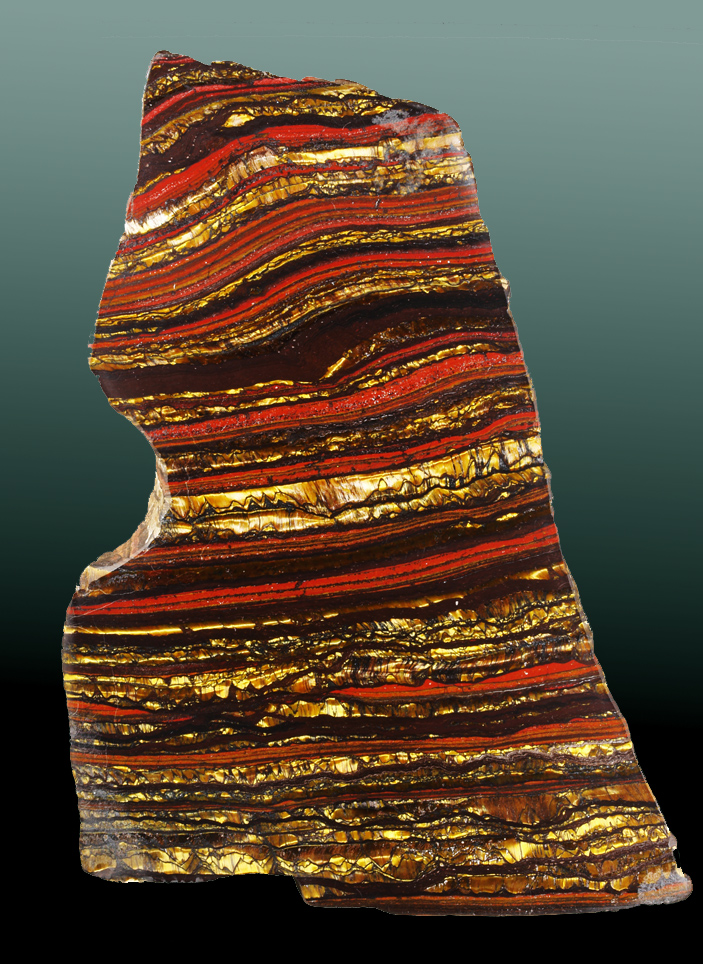
BIF (polished) from Hamersley Iron Formation, West Australia, Australia

Summary: Banded-iron formations (BIFs) are sedimentary mineral deposits consisting of alternating beds of iron-rich minerals (mostly hematite) and silica-rich layers (chert or quartz) formed about 3.0 to 1.8 billion years ago. Theory suggests BIFs are associated with the capture of oxygen released by photosynthetic processes by iron dissolved in ancient ocean water. Once nearly all the free iron was consumed in seawater, oxygen could gradually accumulate in the atmosphere, allowing an ozone layer to form. BIF deposits are extensive in many locations, occurring as deposits, hundreds to thousands of feet thick. During Precambrian time, BIF deposits probably extensively covered large parts of the global ocean basins. The BIFs we see today are only remnants of what were probably every extensive deposits. BIFs are the major source of the world's iron ore and are found preserved on all major continental shield regions. 

Banded-iron formation (BIF)
is 
consists of layers of iron oxides (typically either magnetite or hematite) separated by layers of chert (silica-rich sedimentary rock). Each layer is usually narrow (millimeters to few centimeters). The rock has a distinctively banded appearance because of differently colored lighter silica- and darker iron-rich layers. In some cases BIFs may contain siderite (carbonate iron-bearing mineral) or pyrite (sulfide) in place of iron oxides and instead of chert the rock may contain carbonaceous (rich in organic matter) shale.

It is a chemogenic sedimentary rock (material is believed to be chemically precipitated on the seafloor). Because of old age BIFs generally have been metamorphosed to a various degrees (especially older types), but the rock has largely retained its original appearance because its constituent minerals are fairly stable at higher temperatures and pressures. These rocks can be described as metasedimentary chemogenic rocks.


                     Jaspilite banded iron formation (Soudan Iron-Formation, Soudan, Minnesota, USA
Image Credits: James St. John


In the 1960s, Preston Cloud, a geology professor at the University of California, Santa Barbara, became interested in a particular kind of rock known as a Banded Iron Formation (or BIF). They provide an important source of iron for making automobiles, and provide evidence for the lack of oxygen gas on the early Earth.

Cloud realized that the widespread occurrence of BIFs meant that
the conditions needed to form them must have been common on the ancient Earth, and not common after 1.8 billion years ago. Shale and chert often form in ocean environments today, where sediments and silica-shelled microorganisms accumulate gradually on the seafloor and eventually turn into rock. But iron is less common in younger oceanic sedimentary rocks. This is partly because there are only a few sources of iron available to the ocean: isolated volcanic vents in the deep ocean and material weathered from continental rocks and carried to sea by rivers.


Banded iron-formation (10 cm), Northern Cape, South Africa.
Specimen and photograph: A. Fraser
Most importantly, it is difficult to transport iron very far from these sources today because when iron reacts with oxygen gas, it becomes insoluble (it cannot be dissolved in water) and forms a solidparticle. Cloud understood that for large deposits of iron to exist all over the world’s oceans, the iron must have existed in a dissolved form. This way, it could be transported long distances in seawater from its sources to the locations where BIFs formed. This would be possible only if there were little or no oxygen gas in the atmosphere and ocean at the time the BIFs were being deposited. Cloud recognized that since BIFs could not form in the presence of oxygen, the end of BIF deposition probably marked the first occurrence of abundant oxygen gas on Earth (Cloud, 1968).
Cloud further reasoned that, for dissolved iron to finally precipitate and be deposited, the iron would have had to react with small amounts of oxygen near the deposits. Small amounts of oxygen could have been produced by the first photosynthetic bacteria living in the open ocean. When the dissolved iron encountered the oxygen produced by the photosynthesizing bacteria, the iron would have precipitated out of seawater in the form of minerals that make up the iron-rich layers of BIFs: hematite (Fe2O3) and magnetite (Fe3O4), according to the following reactions:
4Fe3 + 2O2 → 2Fe2O3
6Fe2 + 4O2 → 2Fe3O4
The picture that emerged from Cloud’s studies of BIFs was that small amounts of oxygen gas, produced by photosynthesis, allowed BIFs to begin forming more than 3 billion years ago. The abrupt disappearance of BIFs around 1.8 billion years ago probably marked the time when oxygen gas became too abundant to allow dissolved iron to be transported in the oceans.
Banded Iron Formation
Source is unknown

It is interesting to note that BIFs reappeared briefly in a few places around 700 millionyears ago,during a period of extreme glaciation when evidence suggests that Earth’s oceans were entirely covered with sea ice. This would have essentially prevented the oceans from interacting with the atmosphere, limiting the supply of oxygen gas in the water and again allowing dissolved iron to be transported throughout the oceans. When the sea ice melted, the presence of oxygen would have again allowed the iron to precipitate.

References:

1. Misra, K. (1999). Understanding Mineral Deposits Springer.
2. 
Cloud, P. E. (1968). Atmospheric and hydrospheric evolution on the primitive Earth both secular accretion and biological and geochemical processes have affected Earth’s volatile envelope. Science, 160(3829), 729–736.
3. 
James,H.L. (1983). Distribution of banded iron-formation in space and time. Developments in Precambrian Geology, 6, 471–490.

Wednesday, March 9, 2016

Sedimentary Basins

Sedimentary Basins

The sedimentary veneer on the Earth’s surface varies greatly in thickness. If you stand in central Siberia or south-central Canada, you will find yourself on igneous and metamorphic basement rocks that are over a billion years old sedimentary rocks are nowhere in sight. Yet if you stand along the southern coast of Texas, you would have to drill through over 15 km of sedimentary beds before reaching igneous and metamorphic basement. Thick accumulations of sediment form only in special regions where the surface of the Earth’s lithosphere sinks, providing space in which sediment collects. Geologists use the term subsidence to refer to the process by which the surface of the lithosphere sinks, and the term sedimentary basin for the sediment-filled depression. In what geologic settings do sedimentary basins form? An understanding of plate tectonics theory provides the answers.

Wednesday, July 1, 2015

Ocean basins


Altogether 71% of the area of the globe is occupied by ocean basins that have formed by sea-floor spreading and are floored by basaltic oceanic crust. The midocean ridge spreading centres are typically at 2000 to 2500 m depth in the oceans. Along them the crust is actively forming by the injection of basic magmas from below to form dykes as the molten rock solidifies and the extrusion of basaltic lava at the surface in the form of pillows. This igneous activity within the crust makes it relatively hot. As further injection occurs and new crust is formed, previously formed material gradually moves away from the spreading centre and as it does so it cools, contracts and the density increases. The older, denser oceanic crust sinks relative to the younger, hotter crust at the spreading centre and a profile of increasing water depth away from the mid-ocean ridge results down to around 4000 to 5000 m where the crust is more than a few tens of millions of years old. The ocean basins are bordered by continental margins that are important areas of terrigenous clastic and carbonate deposition. Sediment supplied to the ocean basins may be reworked from the shallow marine shelf areas, or is supplied directly from river and delta systems and bypasses the shelf. There is also intrabasinal material available in ocean basins, comprising mainly the hard part of plants and animals that live in the open oceans, and airborne dust that is blown into the oceans. These sources of sediment all contribute to oceanic deposits. The large clastic depositional systems are mainly found near the margins of the ocean basin, although large systems may extend a thousand kilometres or more out onto the basin plain, and the ocean basin plains provide the largest depositional environments on Earth. The problem with these deep-water depositional systems, however, is the difficulty of observing and measuring processes and products in the present day. The deep seas are profoundly inaccessible places. Our knowledge is largely limited to evidence from remote sensing: detailed bathymetric surveys, side-scan sonar images of the sea floor and seismic reflection surveys of the sediments. There are also extremely localised samples from boreholes, shallow cores and dredge samples. Our database of the modern ocean floors is comparable to that of the surface of the Moon and understanding the sea floor is rather like trying to interpret all processes on land from satellite images and a limited number of hand specimens of rocks collected over a large area. However, our knowledge of deep-water systems is rapidly growing, partly through technical advances, but also because hydrocarbon exploration has been gradually moving into deeper water and looking for reserves in deep-water deposits.

Morphology of ocean basins


Continental slopes typically have slope angles of between 28 and 108 and the continental rise is even less. Nevertheless, they are physiographically significant, as they contrast with the very low gradients of continental shelves and the flat ocean floor. Continental slopes extend from the shelf edge, about 200m below sea level, to the basin floor at 4000 or 5000 m depth and may be up to a hundred kilometres across in a downslope direction. Continental slopes are commonly cut by submarine canyons, which, like their counterparts on land, are steep-sided erosional features. Submarine canyons are deeply incised, sometimes into the bedrock of the shelf, and may stretch all the way back from the shelf edge to the shoreline. They act as conduits for the transfer of water and sediment from the shelf, sometimes feeding material directly from a river mouth. The presence of canyons controls the formation and position of submarine fans. The generally flat surface of the ocean floor is interrupted in places by seamounts, underwater volcanoes located over isolated hotspots. Seamounts may be wholly submarine or may build up above water as volcanic islands, such as the Hawaiian island chain in the central Pacific. As subaerial volcanoes they can be important sources of volcaniclastic sediment to ocean basins. The flanks of the volcanoes are commonly unstable and give rise to very largescale submarine slides and slumps that can involve several cubic kilometres of material. Bathymetric mapping and sonar images of the ocean floor around volcanic islands such as Hawaii in the Pacific and the Canary Islands in the Atlantic have revealed the existence of very large-scale slump features. Mass movements on this scale would generate tsunami around the edges of the ocean, inundating coastal areas. The deepest parts of the oceans are the trenches formed in regions where subduction of an oceanic plate is occurring. Trenches can be up to 10,000 m deep. Where they occur adjacent to continental margins (e.g. the Peru–Chile Trench west of South America) they are filled with sediment supplied from the continent, but mid-ocean trenches, such as the Mariana Trench in the west Pacific, are far from any source of material and are unfilled, starved of sediment.

Depositional processes in deep seas

Deposition of most clastic material in the deep seas is by mass-flow processes. The most common are debris flows and turbidity currents, and these form part of a spectrum within which there can be flows with intermediate characteristics.

Debris-flow deposits

Remobilisation of a mass of poorly sorted, sedimentrich mixture from the edge of the shelf or the top of the slope results in a debris flow, which travels down the slope and out onto the basin plain. Unlike a debris flow on land an underwater flow has the opportunity to mix with water and in doing so it becomes more dilute and this can lead to a change in the flow mechanism and a transition to a turbidity current. The top surface of a submarine debris flow deposit will typically grade up into finer deposits due to dilution of the upper part of the flow. Large debris flows of material are known from the Atlantic off northwest Africa and examples of thick, extensive debris-flow deposits are also known from the stratigraphic record. Debris-flow deposits tens of metres thick and extending for tens of kilometres are often referred to as megabeds.

Turbidites

Dilute mixtures of sediment and water moving as mass flows under gravity are the most important mechanism for moving coarse clastic material in deep marine environments. These turbidity currents carry variable amounts of mud, sand and gravel tens, hundreds and even over a thousand kilometres out onto the basin plain. The turbidites deposited can range in thickness from a few millimetres to tens of metres and are carried by flows with sediment concentrations of a few parts per thousand to 10%. Denser mixtures result in high-density turbidites that have different characteristics to the ‘Bouma Sequences’ seen in low- and medium-density turbidites. Direct observation of turbidity currents on the ocean floor is very difficult but their effects have been monitored on a small number of occasions. In November 1929 an earthquake in the Grand Banks area off the coast of Newfoundland initiated a turbidity current. The passage of the current was recorded by the severing of telegraph cables on the sea floor, which were cut at different times as the flow advanced. Interpretation of the data indicates that the turbidity current travelled at speeds of between 60 and 100 km. Also, the deposits of recent turbidity flows have been mapped out, for example, in the east Atlantic off the Canary Islands a single turbidite deposit has been shown to have a volume of 125 km cube.

High- and low-efficiency systems

A deep marine depositional system is considered to be a low-efficiency system if sandy sediment is carried only short distances (tens of kilometres) out onto the basin plain and a high-efficiency system if the transport distances for sandy material are hundreds of kilometres. High-volume flows are more efficient than small-volume flows and the efficiency is also increased by the presence of fines that tend to increase the density of the flow and hence the density contrast with the seawater. The deposits of low-efficiency systems are therefore concentrated near the edge of the basin, whereas muddier, more efficient flows carry sediment out on to the basin plain. The high-efficiency systems will tend to have an area near the basin margin called a bypass zone where sediment is not deposited, and there may be scouring of the underlying surface, with all the deposition concentrated further out in the basin.

Initiation of mass flows

Turbidity currents and mass flows require some form of trigger to start the mixture of sediment and water moving under gravity. This may be provided by an earthquake as the shaking generated by a seismic shock can temporarily liquefy sediment and cause it to move. The impact of large storm waves on shelf sediments may also act as a trigger. Accumulation of sediment on the edge of the shelf may reach the point where it becomes unstable, for example where a delta front approaches the edge of a continental shelf. High river discharge that results in increased sediment supply can result in prolonged turbidity current flow as sediment-laden water from the river mouth flows as a hyperpycnal flow across the shelf and down onto the basin plain. Such quasi-steady flows may last for much longer periods than the instantaneous triggers that result in flows lasting just a few hours. A fall in sea level exposes shelf sediments to erosion, more storm effects and sediment instability that result in increased frequency of turbidity currents.

Composition of deep marine deposits

The detrital material in deep-water deposits is highly variable and directly reflects the sediment source area. Sand, mud and gravel from a terrigenous source are most common, occurring offshore continental margins that have a high supply from fluvial sources. Material that has had a short residence time on the shelf will be similar to the composition of the river but extensive reworking by wave and tide processes can modify both the texture and the composition of the sediment before it is redeposited as a turbidite. A sandstone deposited by a turbidity current can therefore be anything from a very immature, lithic wacke to a very mature quartz arenite. Turbidites composed wholly or partly of volcaniclastic material occur in seas offshore of volcanic provinces. The deep seas near to carbonate shelves may receive large amounts of reworked shallow-marine carbonate sediment, redeposited by turbidity currents and debris flows into deeper water: recognition of the redeposition process is particularly important in these cases because the sediment will contain bioclastic material that is characteristic of shallow water environments. Because there is this broad spectrum of sandstone compositions in deep-water sediments, the use of the term ‘greywacke’ to describe the character of a deposit is best avoided: it has been used historically as a description of lithic wackes that were deposited as turbidites and the distinction between composition and process became confused as the terms turbidite and greywacke came to be used almost as synonyms. ‘Greywacke’ is not part of the Pettijohn classification of sandstones and it no longer has any widely accepted meaning in sedimentology.