Showing posts with label igneous. Show all posts

Sunday, April 23, 2017

Geologic Contacts

A geologic contact is where one rock type touches another. There are three types of geologic contact:1. Depositional contacts are those where a sedimentary rock (or a lava flow) was deposited on an older rock
2. Intrusive contacts are those where one rock has intruded another
3. Fault contacts are those where rocks come into contact across fault zones.
Learn in detail about fault here

Following are the some pictures showing each type of geologic contact

Depositional Contacts

1. Angular Unconformity, Siccar Point, Scotland

This place is known as Siccar Point which is the most important unconformity described by James Hutton (1726-1797) in support of his world-changing ideas on the origin and age of the Earth.
Here 
gently sloping strata of 370-million-year-old Famennian Late Devonian Old Red Sandstone and a basal layer of conglomerate overlie near vertical layers of 435-million-year-old lower Silurian Llandovery Epoch greywacke, with an interval of around 65 million years.


2. Cretaceous Sandstone overlying Conglomerate    Kootenai Formation, SW Montana

Photo Courtesy: marlimillerphoto.com

3. Dun Briste Sea Stack, IrelandDun Briste is a truly incredible site to see but must be visited to appreciate its splendour. It was once joined to the mainland. The sea stack stands 45 metres (150 feet) tall.

Dun Briste and the surrounding cliffs were formed around 350 million years ago (during the 'Lower Carboniferous Period'), when sea temperatures were much higher and the coastline at a greater distance away.  There are many legends describing how the Sea Stack was formed but it is widely accepted that an arch leading to the rock collapsed during very rough sea conditions in 1393. This is remarkably recent in geological terms

Photo Courtesy: dunbriste.com 


Fault Contacts

1. Normal Faulting in the Cutler Formation near Arches National Park

Photo Courtesy: travelinggeologist.com

2. Normal Fault in Titus Canyon, Death Valley, California 

Photo Courtesy: travelinggeologist.com


3. 
Horst and Graben Structure in Zanjan, Iran

Photo Courtesy: Amazhda

Intrusive Contacts 

1. 
Pegmatite and aplite dikes and veins in granitic rocks on Kehoe Beach, Point Reyes National Seashore, California.


2. Spectacular mafic dyke from Isla de Socorro from Pep Cabré. The Isla de Socorro is a volcanic island off the west coast of Mexico and it is the only felsic volcano in the Pacific Ocean

Photo Courtesy: travelinggeologist.com

3. The margins of this Granite dyke cooled relatively quickly in contact with this much older Gabbro.
Photo near Ai-Ais Namibia

Photo Courtesy: travelinggeologist

Tuesday, December 27, 2016

10 of the Best Learning Geology Photos of 2016

A picture is worth a thousand words, but not all pictures are created equal. The pictures we usually feature on Learning Geology are field pictures showing Geological structures and features and many of them are high quality gem and mineral pictures. The purpose is to encourage students and professionals' activities by promoting "learning and scope" of Geology through our blogs.
In the end of 2016, we are sharing with you the 10 best photos of 2016 which we have posted on our page.

P.S: we always try our best to credit each and every photographer or website, but sometimes it’s impossible to track some of them. Please leave a comment if you know about the missing ones.

1. Folds from Basque France

 Image Credits: Yaqub ShahYaqub Shah

2. Horst and Graben Structure in Zanjan, Iran


Image Credits: https://www.instagram.com/amazhda


3. A unique Normal Fault

4. The Rock Cycle
The
 rock cycle illustrates the formation, alteration, destruction, and reformation of earth materials, and typically over long periods of geologic time. The rock cycle portrays the collective system of processes, and the resulting products that form, at or below the earth surface.The illustration below illustrates the rock cycle with the common names of rocks, minerals, and sediments associated with each group of earth materials: sediments, sedimentary rocks, metamorphic rocks, and igneous rocks.


Image Credits: Phil Stoffer


5. An amazing Botryoidal specimen for Goethite lovers! 


Image Credits: Moha Mezane 
   

6. Basalt outcrop of the Semail Ophiolite, Wadi Jizzi, Oman

Image Credits: Christopher Spencer
Christopher Spencer is founder of an amazing science outreach program named as Traveling Geologist. Visit his website to learn from him


7. Val Gardena Dolomites, Northern Italy


8. Beautiful fern fossil found in Potsville Formation from Pennsylvania.
The ferns most commonly found are Alethopteris, Neuropteris, Pecopteris, and Sphenophyllum.


Image Credits: Kurt Jaccoud


9. Snowball garnet in schist

Syn-kinematic crystals in which “Snowball garnet” with highly rotated spiral Si. 

Porphyroblast is ~ 5 mm in diameter.
From Yardley et al. (1990) Atlas of Metamorphic Rocks and their Textures.


10. Trilobite Specimen from Wheeler Formation, Utah
The Wheeler Shale is of Cambrian age and is a world famous locality for prolific trilobite remains. 


Image Credits: Paleo Fossils

Sunday, March 6, 2016

How Do You Describe an Igneous Rock?

How Do You Describe an Igneous Rock? 

Different parameters are used to describe an igneous rock which are described in detail.

Characterizing Color and Texture 

If you wander around a city admiring building facades, you’ll find that many facades consist of igneous rock, for such rocks tend to be very durable. If you had to describe one of these rocks to a friend, what words might you use? You would  probably start by noting the rock’s colour. Overall, is the rock dark or light? More specifically, is it gray, pink, white, or black? Describing colour may not be easy, because some igneous rocks contain many visible mineral grains, each with a different colour; but even so, you’ll probably be able to characterize the overall hue of the rock. Generally, the colour reflects the rock’s composition, but it isn't always so simple, because colour may also be influenced by grain size and by the presence of trace amounts of impurities. (For example, the presence of a small amount of iron oxide gives rock a reddish tint.) Next, you would probably characterize the rock’s texture. A description of igneous texture indicates whether the rock consists of glass, crystals, or fragments. If the rock consists of crystals or fragments, a description of texture also specifies the grain size. Here are the common terms for defining texture:

Saturday, March 5, 2016

How Do Extrusive and Intrusive Environments Differ?

How Do Extrusive and Intrusive Environments Differ? 

With a background on how melts form and freeze, we can now introduce key features of the two settings intrusive and extrusive in which igneous rocks form.

Extrusive Igneous Settings 

Different volcanoes extrude molten rock in different ways. Some volcanoes erupt streams of low-viscosity lava that flood down the flanks of the volcano and then cover broad swaths of the countryside. When this lava freezes, it forms a relatively thin lava flow. Such flows may cool in days to months. In contrast, some volcanoes erupt viscous masses of lava that pile into rubbly domes. And still others erupt explosively, sending clouds of volcanic ash and debris skyward, and/or avalanches of ash tumbling down the sides of the volcano.

Wednesday, November 4, 2015

Nature of magma

Magma nature


Magma is a term first introduced into geologic literature in 1825 by Scope, who referred to it as a “compound liquid” consisting of solid particles suspended in a liquid, like mud. Measurements on extruded magma (lava), together with evaluations of mineral geothermometers in magmatic rocks and experimental determinations of their melting relations, indicate that temperatures of magmas near the surface of the Earth generally range from about 1200°C to 700°C; the higher values pertain to mafic compositions, the lower to silicic. Very rare alkali carbonatitic lavas that contain almost no silica have eruptive temperatures of about 600°C. Extruded magmas are rarely free of crystals, indicating that they rarely are superheated above temperatures of crystallization. Densities of magmas range from about 2.2 to 3.0 g/cm3 and are generally about 90% of that of the equivalent crystalline rock.
Magma in general consists of a mobile mixture of solid, liquid, and gaseous phases. The number and nature of the phases constituting a magma depend, under stable equilibrium conditions, on the three intensive variables P, T, and X (concentrations of chemical components in the magma). At sufficiently high T, any rock melts completely to form a homogeneous liquid solution, or melt. Except for carbonatite magmas, melts consist mostly of ions of O and Si hence the alternate appellation silicate liquid but always contain in addition significant amounts of Al, Ca, H, Na, and so on.
Examples of different types of magmas are shown schematically in below figure. Only in some unusually hot systems will a magma consist wholly of melt and no other phases. In most instances, a melt is only part of the whole magma, but is always present and gives it mobility. Hence, melt and magma are generally not the same. To a significant extent, the properties of the melt largely govern the overall dynamic behaviour of the whole magma. Rare magma systems consist at equilibrium of two physically distinct melts one essentially of carbonate and the other of silicate, or both are silicate but one is silicic and the other very rich in Fe. Each of these immiscible melts has distinctive properties, such as density. Oil and water are familiar immiscible liquids.
Schematic possible magmas

Atomic Structure of Melts

The configuration of ions in a melt its atomic structure largely dictates many of its significant properties. In pictorial representations of crystalline, liquid, and gaseous states, individual atoms have to be drawn as fixed in position relative to one another, but these are only their average, or instantaneous, positions. Even in crystals above absolute zero (0K), individual ions have motion. In glasses that are supercooled very viscous melts, ions experience vibrational motion: small periodic displacements about an average position. But at temperatures above a glass-melt transition, approximately two-thirds to three-quarters the melting T in degrees Kelvin, ions in the melt have more mobility and can break their bonds with neighbouring ions and wander about, forming new configurations. In a flowing melt, bonds are broken and bond angles and distances are distorted, but after deformation ceases, the ionic array may have sufficient time to reform into a “relaxed” equilibrium structure.
Many studies of melts in the laboratory using nuclear magnetic resonance, vibrational spectroscopy, and X-ray analyses reveal a lack of long-range (on the scale of more than a few atomic bond lengths) structural order and symmetry that characterize crystals. However, melts possess a short-range structural order in which tetrahedrally coordinated Si and Al cations are surrounded by four O anions and octahedrally bonded cations such as Ca and Fe2+ surrounded by six O anions roughly resemble those in crystals. Because silica is the most abundant constituent in most natural melts, the fundamental structural unit is the (SiO4)4 - tetrahedron, as it is in silicate minerals. Conceptual models of the atomic structure of silicate liquids can be constructed on the basis of these observations. Figure below depicts these models for liquid silica (SiO2) and CaMgSi2O6; the latter in crystalline form is diopside pyroxene.
Conceptual models of atomic structures of silicate melts compared with the symmetric lattice of a crystalline solid. (a) Crystalline silica (high tridymite). Layers of hexagonal rings of Si-O tetrahedra with alternating apices pointing up and down are stacked on top of one another, creating a three-dimensional structure in which each oxygen is shared by two silicons. Tetrahedra with apices pointing up have the upper apical oxygen left out of the drawing so as to reveal underlying silicon. Dashed line indicates outline of one unit cell in the lattice. (b) Model of liquid silica. Si-O tetrahedra are slightly distorted relative to the crystalline lattice. Long-range order is absent. Structure is highly polymerized because all tetrahedra are interconnected by bridging oxygen anions. (c) Model of liquid CaMgSi2O6 showing less polymerization than that of liquid silica. Note presence of network-modifying cations (Ca and Mg) and non-bridging oxygen, neither of which occurs in the silica melt. 
Because the entropy of melting of crystalline silica (i.e., the change in entropy from the crystalline to the liquid state) is relatively small, there can be little change in the degree of order in the atomic structure of the melt relative to the crystalline state. Thus, a model for liquid silica is a three-dimensional network of somewhat distorted Si-O tetrahedra, not unlike the corresponding structure of crystalline silica. Short range order is roughly similar to that in the crystalline state, but long-range order, as would be evident in a symmetrical crystal lattice, is absent. The silica melt can be viewed as a three-dimensional network of interlinked chains, or polymers, of Si-O tetrahedra.
On the other hand, in the model of the CaMgSi2O6 melt, these string like polymers are shorter, less intricately linked, and interspersed among octahedrally coordinated cations of Ca and Mg. This melt is not as polymerized as liquid silica.
Four different types of ions can be recognized in these models (Figure above) on the basis of their relation to the polymers: 
  1. Network-forming cations of Si4 within the interconnected tetrahedra of the polymers are strongly linked by 
  2. bridging oxygens. 
  3. Network-modifying cations of Ca and Mg are more weakly bonded to 
  4. non-bridging oxygens in non-tetrahedral bonding arrangements. 
The ratio of non-bridging oxygens to network-forming, tetrahedrally coordinated cations chiefly Si and Al is a measure of the degree of polymerization in a melt; small ratios correspond to high degrees of polymerization. In completely polymerized liquid silica, the ratio = 0. In partially polymerized liquid CaMgSi2O6 it is = 2/1 = 2.
The atomic structure of naturally occurring melts is more complex than these simple models. Despite considerable research, many details are not understood. Other ions of different size, charge, and electro-negativity, such as Al3+ , Ti4 +, Fe3+ , P5+ , H- , or F- make natural melts more complex. In this milieu, mobile cations compete for available anions, principally oxygen, in order to satisfy bonding requirements and to minimize the free energy of the melt. This is not quite the same situation as in crystals, where cations have more or less fixed sites of a particular coordination in the ordered lattice. In addition to the widespread (SiO4)4 - tetrahedra in melts, there are less abundant neighbouring tetrahedra of more negatively charged (Al3+ O4)5 - and (Fe3+ O4)5 -. The ionic charge and size of network-modifying cations, which generally form weaker bonds with non-bridging oxygens, can play an important role in melt structure. Network modifiers most commonly include monovalent K and Na; divalent Ca, Mg, Fe, and Mn, and more highly charged, but less abundant high-field-strength cations including P5+ , Ti4 +, and the still less abundant trace elements.
The most important dynamic property of a melt its viscosity depends strongly on its atomic structure. Because viscosity is a measure of the ease of flow of a melt and the mobility of ions, it should be intuitively obvious that more highly polymerized melts are more viscous. Alternatively, it can be said that, because non-bridging oxygen anions are less strongly bonded to neighbouring cations than bridging oxygens to Si and Al, viscosity correlates with the ratio of non-bridging to bridging oxygens. Increased concentrations of some components can depolymerize melts and reduce viscosity. Even small weight proportions of dissolved water or fluorine can depolymerize silicate melts, making them much less viscous. Also, high-field-strength, network-modifying cations whose charge is generally > 3+ have a strong affinity for oxygen anions and may successfully compete against network-forming Si4+ , Al3+ , and Fe3+ , thus depolymerizing the melt. The role of Fe in melt structures is especially significant because it occurs in two oxidation states. Fe2+ appears to be exclusively a network modifier, whereas Fe3+ can be either a network modifier or a network former. Changes in the oxidation state can therefore affect the degree of polymerization of a melt.
Increasing pressure appears to reduce the degree of polymerization somewhat. Because octahedral coordination of Si and Al is favoured in crystalline structures at high P over tetrahedral coordination, similar coordination changes might occur in melts at high P. Some experiments suggest that Al more readily shifts toward octahedral coordination with increasing P than does Si.
In conclusion, water-free (“dry”) rhyolite melts have virtually no non-bridging oxygens and are nearly completely polymerized and highly viscous. In andesite melts the ratio of non-bridging oxygens to network forming, tetrahedrally coordinated cations is about 0.2, and in basalt melts it is 0.4–1.2. Consequently, mafic, silica-poor melts are significantly less polymerized and less viscous than dry silicic melts.

Monday, November 2, 2015

Elementary concepts of thermodynamics

Elementary concepts of thermodynamics

Thermodynamic States, Processes, and State Variables

Geologic systems parts of the universe set aside in our mind for investigation are commonly more complex than, for example, the systems of a laboratory chemist. Geologic systems can be as large as the entire Earth and may endure for millions of years; they tend to be poorly definable and ever changing. Ideal end member systems in figure below are as follows:
  1. Isolated system: No matter or energy can be transferred across the boundary of the system and no work can be done on or by the system. Considering the span of time over which most identifiable geologic systems operate, no part of the Earth, nor even all of it, can be considered perfectly isolated because transfers of energy and movement of matter typify the dynamic Earth.
  2. Open system: The opposite of an isolated system. Matter and energy can flow across the boundary and work can be done on and by the system. Most geologic systems are open, at least in the context of their long lifetimes.
  3. Closed system: Energy, such as heat, can flow across the boundary of the system, but matter cannot. The composition of the system remains exactly constant. Because movement of matter is slow across boundaries of, for example, a rapidly cooling thin dike, it can be considered to be virtually closed. On the other hand, a large intrusion of magma that remains molten for tens of thousands of years while various fluids move across the wall rock contact is not a closed system.
  4. Adiabatic system: A special category of an isolated system is one in which no heat can be exchanged between the system and the surroundings. It is thermally insulated, but energy can be transferred across the system boundary through work done on or by it. Thus, an ascending, decompressing mantle plume or magma body cools as it expands against and does PV work on the surroundings, into which little heat is conducted because the rate of conduction is so slow.
End-member thermodynamic systems. Classification is according to flows of matter and energy across their boundary with the surroundings.
Any thermodynamic state of a system can be characterized by its state properties, or state variables.
Some state properties are extensive in that they depend on the amount of material, such as the mass and volume of some chemicals constituting a system. Other state properties are intensive and are independent of the amount of material present; they have a definite value at each point within the system, such as T, P, and concentration of a particular chemical species. Density (mass/volume) is also an intensive property. For example, at T 25°C and P 1 atm, the density of stable graphite anywhere within a crystal is 2.23 g/cm3 whereas that of diamond is 3.51 g/cm3.
P and T are extremely important intensive variables whose change in rock-forming systems is responsible for changes in their state; for example, increasing T causes solid rock to melt. Values of the geobaric and geothermal gradients in the Earth can be used to approximate P and T at a particular depth, assuming these gradients to be uniform. Otherwise uniform gradients can locally be perturbed, such as the geothermal gradient around a shallow crustal magma intrusion.
Rock-forming geologic processes can be thought of as thermodynamic processes: those that affect a thermodynamic system as it changes from one state to another.. In a thermodynamic process there could be all kinds of work done on or by the system, flows of heat in or out, chemical reactions and movement of matter, tortuous paths taken, and so forth. However, two ideal, end-member thermodynamic processes can be recognized: irreversible and reversible. In an irreversible thermodynamic process the initial state is metastable, and the spontaneous change in the system leads to a more stable, lower-energy final state. The conversion of metastable volcanic glass into more stable crystals a process called devitrification under near-atmospheric conditions is one example of an irreversible process. The energy trough in which metastable glass is stuck has to be surmounted, overcoming the activation energy, before it can move to a lower energy state. The atomic bonds in the glass must be broken or reformed into more stable crystalline structures. Devitrification of glass occurs spontaneously in the direction of diminishing energy, never in reverse (Figure below).
Spontaneous, irreversible thermodynamic process. A system in an initial higher-energy metastable state moves spontaneously to a lower-energy, stable state. The reverse never happens spontaneously.
In a reversible process, both initial and final states are stable equilibrium states and the path between them is a continuous sequence of equilibrium states. A reversible process is never actually realized in nature; it is a hypothetical concept that is used to make the mathematical models of thermodynamics work, and that’s all that can be said without an extended discussion.

First Law of Thermodynamics

Suppose that a change in the internal energy, dEi of a rock system, such as a mineral grain, is produced by adding some amount of heat to it, dq. As a result of absorbing heat, the mineral grain expands by an increment in volume, dV, doing an increment of PV work, dw PdV, on the surrounding mineral grains. According to the first law of thermodynamics, or law of conservation of energy, the increase in internal energy due to heat absorbed is diminished by the amount of work done on the surroundings, or
(1) dEi = dq - dw = dq - PdV
In the “scientific” convention, heat added to (or work done on) a system, as in this formulation, is positive and work done by (or heat withdrawn from) the system on its surroundings is negative.

Enthalpy

A new state property, the enthalpy, H, is defined here as
(2) H = Ei + PV
Upon differentiation, this equation becomes dH = dEi + PdV + VdP. Combining with equation (1) gives
(3) dH = dq + VdP
For isobaric (constant-pressure) changes, dP = 0, equation (3) becomes
(4) dHp = dqp
Although H may appear to be simply another and unnecessary label for q, the enthalpy is significant in providing a measure at constant P of how much heat is gained or lost from a system. Three possible changes in a system are accompanied by a gain or loss of heat, as follows:
  1. 1. Chemical reactions, such as the reaction of quartz plus calcite creating wollastonite plus CO2.
  2. 2. A change in state, such as crystals melting to liquid, that occurs at a fixed T once that T is reached in heating a system.
  3. 3. A change in T of the system where no change in state occurs, such as simply heating crystals below their melting T. 
The last two changes can be illustrated by a plot of enthalpy versus T for the diopside CaMgSi2O6 system as it is heated at constant P (Figure below). As diopside crystals absorb heat up to their melting point, T increases proportionally with the heat capacity, Cp. The slope of this line is (dH/dT)p Cp. At the melting T absorbed heat does not increase T, but is consumed in breaking the atomic bonds of the crystalline structure to produce the more random liquid array. This relatively large amount of absorbed heat at the constant T of melting, is the latent heat of melting, or enthalpy of melting, Hm. Once melting is complete, additional input of heat into the system raises the T of the melt proportional to its heat capacity. The slopes of the T-H lines above and below the
melting point are the heat capacities of the melt and the
crystals, respectively.
Note in Figure below that the latent heat involved in changing the state of the system from liquid to crystal, or vice versa, is similar to the heat absorbed in changing the T of the crystals or liquid by hundreds of degrees. Thus, melting of rock in the Earth to generate magma absorbs a vast amount of thermal energy, which moderates changes in T in the system.
Enthalpy-T relations for CaMgSi2O6 at 1 atm. 
They are either exothermic or endothermic, respectively. If catalyzed by a spark, the reaction between hydrogen and oxygen releases a burst of heat a rapid exothermic reaction, or explosion. Solidification of magma exothermically releases the latent heat of crystallization. In contrast, dissolution of potassium nitrate in water endothermically absorbs heat so that the container becomes cold. Thus, whether heat is released or absorbed in a chemical reaction provides no consistent clue as to the direction a reaction moves spontaneously.

Entropy and the Second and Third Laws of Thermodynamics

Another way to look at spontaneity is in changes in the distribution or concentration of energy. Spontaneous thermal processes lead to a more even concentration of heat. A bowl of hot soup on the table eventually reaches the same T as the room. Heat flows spontaneously from a hot body to a cold, eliminating the difference in T. Without an uneven concentration of thermal energy, or the opportunity for heat flow, no work can be done. As heat flows from an intrusion of hotter magma into the cooler wall rocks, PV work of volumetric expansion is performed on them. The heat also drives endothermic chemical reactions of wall rock metamorphism. Water in an enclosed lake on a high plateau has gravitational potential energy relative to sea level, but so long as it is isolated from sea level and cannot flow, the concentration of energy is uniform and no work can be done. However, in the natural course of events, a river drains the lake into the sea, forming a process path along the potential energy gradient between the high- and low potential-energy levels. Work can then be done, driving turbines to generate electricity, eroding the river channel, transporting sediment, and so on.
One statement of the second law of thermodynamics is that spontaneous natural processes tend to even out the concentration of some form of energy, smoothing the energy gradient. A hot lava flow extruded from a lofty volcano cools to atmospheric T as it descends down slope, thereby reducing differences in thermal and gravitational potential energy between initial and final states in accordance with the second law.
Eventually, billions of years from now, all of the thermal energy in the Earth will be consumed in tectonism, volcanism, and other processes and dispersed into outer space. No mountains or volcanoes will be erected and erosion in the solar-powered hydrologic system will wear everything down to some common level (assuming the Sun does not run out of nuclear energy!). Without differences in the concentration of thermal and gravitational potential energy no geologic work can be accomplished and the planet will be geologically dead!. 
The measure of the uniformity in concentration of energy in a system is called the entropy, S. The more uniform the concentration of some form of energy, the greater the entropy. The geologically dead planet will have maximal entropy.
Another, more useful, way to define entropy is to relate it to the internal disorder in the system. This provides an alternate statement of the second law: In any spontaneous process in an isolated system there is an increase in entropy, that is, an increase in disorder. The law in this form is illustrated by Figure 3.4, where white and black balls in the boxes represent molecules of two different gases. The spontaneous mixing of the two gas molecules results in an increase in “mixedupness,” disorder, randomness, or entropy. Note that there is no accompanying change in energy in this mixing process. Thus, another driving “force” for a spontaneous process is an increase in entropy, even though there may be no change in the energy.
At decreasing T, crystals become increasingly ordered, less atomic substitution is possible, and their entropy decreases. The third law of thermodynamics states that at absolute zero, where the Kelvin temperature is zero (0K = - 273.15°C), crystals are perfectly ordered and all atoms are fixed in space so that the entropy is zero.
A convenient way to think of relative entropies is that a gas made of high-speed molecules in random trajectories has a greater entropy than the compositionally equivalent liquid array, which, though still somewhat disordered, has linked atoms. The compositionally equivalent crystalline solid has still lower entropy, because its atoms form an ordered array. As an example, for water,
Ssteam > Sliquid water > Sice

Gibbs Free Energy

The boulder-on-the-hill example has two major flaws as an analogy for the way natural systems, in general, change spontaneously from a higher to a lower energy state. First, it isn’t always gravitational potential energy that is minimized. Second, the analogy does not take into account the fact that in an isolated system a process can proceed spontaneously without any change in energy, but it does proceed with increasing entropy figure below. To overcome these two flaws, a new extensive property of a system is defined in such a way as to serve as a universal directionality pointer for spontaneous reactions. 
Entropy increases in a spontaneous, irreversible process in an isolated system. Bottom left, a hypothetical isolated system a box filled with atoms of two gases (black and white balls) separated by an impermeable wall. Bottom right, the wall has been removed in the box, and the atoms of the two gases have mixed spontaneously and irreversibly as a result of their motion (kinetic energy). An increase in disorder or randomness of the atoms in the system and an increase in entropy, S > 0. No change in energy has occurred.

This new property is called the Gibbs free energy, G, and is defined by the expression
G = H + TS. Combining with equation (2)
(6) G = Ei + PV - TS
In differential form this becomes
(7) dG = dEi + PdV + VdP - TdS - SdT
Remembering the work-pressure-volume relation (dW = PdV), we can write a parallel expression for the heat temperature-entropy relation
(8) dq = TdS
Equation 97) can be simplified by substituting this equality and also by making a substitution from equation (2) to obtain
(9) dG = VdP - SdT
Equation (9) is a useful thermodynamic expression that allows us to make powerful statements regarding the direction of changes in geologic systems as the independent intensive variables of state, T and P, change. The extensive entropy and volume properties of the system are also relevant factors.
If P and T remain the same through any spontaneous change in state, that is, dP = dT = 0, then, from
equation (9)
(10) dGP,T = 0
This is simply the condition for a minimum (or maximum) in G in P-T space where the slope of the tangent to the energy function is zero, or horizontal. Figure below shows a system that has moved to a state of minimal energy and stable equilibrium from a higher-energy, metastable state at constant P and T in a closed (constant composition) system. Note that the energy change,  GP,T, between the initial metastable state and the final stable state is negative: GP,T < 0.
In some spontaneously changing systems, increasing entropy is the dominant factor, whereas in  thers, decreasing energy is the dominant factor. The Gibbs free energy is formulated in such a way that it always decreases in a spontaneous change in the state of a system.
In other words, the Gibbs free energy of the final stable state is lower than that of the initial metastable state in figure below. The Gibbs free energy is a thermodynamic potential energy that, like gravitational potential energy for the hypothetical boulders, is the lowest possible in a state of stable equilibrium for a changing system.

Gibbs free energy decreases in a spontaneous change in a closed system where the initial and final states are at the same P and T. In this example, the energy of diamond is greater than that of graphite at the same P and T, or Gdiamond > Ggraphite, so the change in energy, GP,T, in the spontaneous process is negative, or Gdiamond - Ggraphite = GP,T < 0. Note the activation energy barrier, Ea , that must be surmounted in order for the change to occur.


Wednesday, September 30, 2015

Volcanism and Igneous Rocks

Magma and Igneous Rocks


Igneous Rocks are  formed by crystallization from a liquid, or magma. They include two types
  • Volcanic or extrusive  igneous rocks form when the magma cools and crystallizes on the surface of the Earth
  • Intrusive or plutonic igneous rocks wherein the magma crystallizes at depth in the Earth.
Magma is a mixture of liquid rock, crystals, and gas. Characterized by a wide range of chemical compositions, with high temperature, and  properties of a liquid.
Magmas are less dense than surrounding rocks, and will therefore move upward. If magma makes it to the surface it will erupt and later crystallize to form an extrusive or volcanic rock. If it crystallizes before it reaches the surface it will form an igneous rock at depth called aplutonic or intrusive igneous rock.
  
Types of Magma
Chemical composition of magma is controlled by the abundance of elements in the Earth. Si, Al, Fe, Ca, Mg, K, Na, H, and O make up 99.9%. Since oxygen is so abundant, chemical analyses are usually given in terms of oxides. SiO2 is the most abundant oxide.
  1. Mafic or Basaltic--  SiO2 45-55 wt%, high in Fe, Mg, Ca, low in K, Na 
  2. Intermediate or Andesitic--  SiO2 55-65 wt%, intermediate. in Fe, Mg, Ca, Na, K 
  3. Felsic or Rhyolitic--  SiO2 65-75%, low in Fe, Mg, Ca, high in K, Na.
Gases - At depth in the Earth nearly all magmas contain gas.  Gas gives magmas their explosive character, because the gas expands as pressure is reduced.
  • Mostly H2O with some CO2 
  • Minor amounts of Sulfur, Cl , and F 
  • Felsic magmas usually have higher gas contents than mafic magmas.
Temperature of Magmas
  • Mafic/Basaltic - 1000-1200o
  • Intermediate/Andesitic -  800-1000o
  • Felsic/Rhyolitic -  650-800oC.
Viscosity of Magmas


Viscosity is the resistance to flow (opposite of fluidity). Depends on composition, temperature, & gas content.  
  • Higher SiO2 content magmas have higher viscosity than lower SiO2 content magmas 
  • Lower Temperature magmas have higher viscosity than higher temperature magmas.

                
Summary Table
Magma TypeSolidified Volcanic RockSolidified Plutonic RockChemical CompositionTemperatureViscosityGas Content
Mafic or BasalticBasaltGabbro45-55 SiO2 %, high in Fe, Mg, Ca, low in K, Na1000 - 1200 oCLowLow
Intermediate
or Andesitic
AndesiteDiorite55-65 SiO2 %, intermediate in Fe, Mg, Ca, Na, K800 - 1000 oCIntermediateIntermediate
Felsic or RhyoliticRhyoliteGranite65-75 SiO2 %, low in Fe, Mg, Ca, high in K, Na650 - 800 oCHighHigh
  

Origin of Magma
As we have seen the only part of the earth that is liquid is the outer core.  But the core is not likely to be the source of magmas because it does not have the right chemical composition.  The outer core is mostly Iron, but magmas are silicate liquids.  Thus magmas DO NOT COME FROM THE MOLTEN OUTER CORE OF THE EARTH.  Thus, since the rest of the earth is solid, in order for magmas to form, some part of the earth must get hot enough to melt the rocks present. We know that temperature increases with depth in the earth along thegeothermal gradient.  The earth is hot inside due to heat left over from the original accretion process, due to heat released by sinking of materials to form the core, and due to heat released by the decay of radioactive elements in the earth.  Under normal conditions, the geothermal gradient is not high enough to melt rocks, and thus with the exception of the outer core, most of the Earth is solid.  Thus, magmas form only under special circumstances.  To understand this we must first look at how rocks and mineral melt.
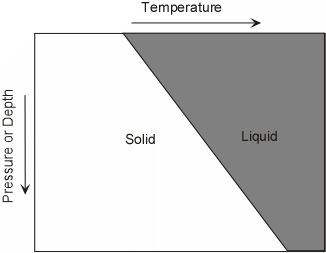
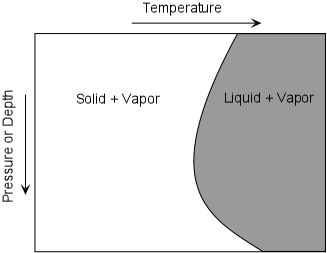
As pressure increases in the Earth, the melting temperature changes as well.  For pure minerals, there are two general cases.

  
  • For a pure dry (no H2O or CO2present) mineral, the melting temperate increases with increasing pressure.
  • For a mineral with H2O or CO2present, the  melting temperature first decreases with increasing pressure

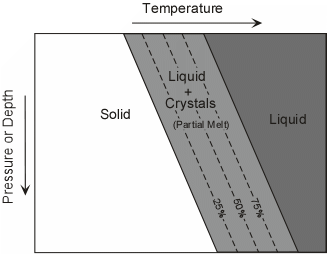
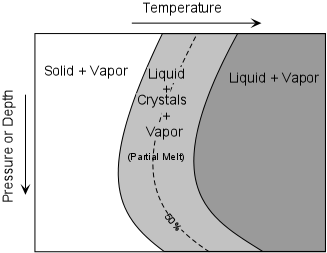
Since rocks mixtures of minerals, they behave somewhat differently.  Unlike minerals, rocks do not melt at a single temperature, but instead melt over a range of temperatures.  Thus, it is possible to have partial melts from which the liquid portion might be extracted to form magma.  The two general cases are:
  • Melting of dry rocks is similar to melting of dry minerals, melting temperatures increase with increasing pressure, except there is a range of temperature over which there exists a partial melt.  The degree of partial melting can range from 0 to 100%
  • Melting of rocks containing water or carbon dioxide is similar to melting of wet minerals, melting temperatures initially decrease with increasing pressure, except there is a range of temperature over which there exists a partial melt.
WetRockMelt.GIF (9309 bytes)


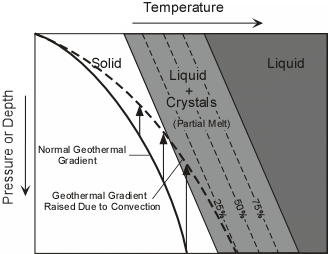
Three ways to Generate MagmasFrom the above we can conclude that in order to generate a magma in the solid part of the earth either the geothermal gradient must be raised in some way or the melting temperature of the rocks must be lowered in some way.
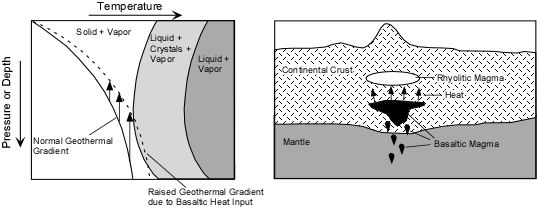
The geothermal gradient can be raised by upwelling of hot material from below either by uprise solid material (decompression melting) or by intrusion of magma (heat transfer). Lowering the melting temperature can be achieved by adding water or Carbon Dioxide (flux melting).
Decompression Melting  - Under normal conditions the temperature in the Earth, shown by the geothermal gradient, is lower than the beginning of melting of the mantle.  Thus in order for the mantle to melt there has to be a mechanism to raise the geothermal gradient.  Once such mechanism is convection, wherein hot mantle material rises to lower pressure or depth, carrying its heat with it. 
If the raised geothermal gradient becomes higher than the initial melting temperature at any pressure, then a partial melt will form.  Liquid from this partial melt can be separated from the remaining crystals because, in general, liquids have a lower density than solids.  Basaltic magmas appear to originate in this way.
Upwelling mantle appears to occur beneath oceanic ridges, at hot spots, and beneath continental rift valleys.  Thus, generation of magma in these three environments is likely caused by decompression melting.
  
Transfer of Heat-  When magmas that were generated by some other mechanism intrude into cold crust, they bring with them heat.  Upon solidification they lose this heat and transfer it to the surrounding crust.   Repeated intrusions can transfer enough heat to increase the local geothermal gradient and cause melting of the surrounding rock to generate new magmas.
Transfer of heat by this mechanism may be responsible for generating some magmas in continental rift valleys, hot spots, and subduction related environments.
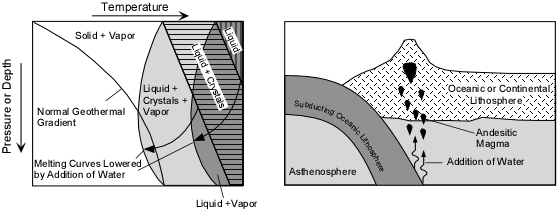

Flux Melting - As we saw above, if water or carbon dioxide are added to rock, the melting temperature is lowered.   If the addition of water or carbon dioxide takes place deep in the earth where the temperature is already high, the lowering of melting temperature could cause the rock to partially melt to generate magma.  One place where water could be introduced is at subduction zones. Here, water present in the pore spaces of the subducting sea floor or water present in minerals like hornblende, biotite, or clay minerals would be released by the rising temperature and then move in to the overlying mantle.   Introduction of this water in the mantle would then lower the melting temperature of the mantle to generate partial melts, which could then separate from the solid mantle and rise toward the surface.


Chemical Variability of Magmas
The chemical composition of magma can vary depending on the rock that initially melts (the source rock), and process that occur during partial melting and transport.
Initial Composition of Magma
The initial composition of the magma is dictated by the composition of the source rock and the degree of partial melting.   In general, melting of a mantle source (garnet peridotite) results in mafic/basaltic magmas.  Melting of crustal sources yields more siliceous magmas.
In general more siliceous magmas form by low degrees of partial melting. As the degree of partial melting increases, less siliceous compositions can be generated. So, melting a mafic source thus yields a felsic or intermediate magma. Melting of ultramafic (peridotite source) yields a basaltic magma.
Magmatic Differentiation
But, processes that operate during transportation toward the surface or during storage in the crust can alter the chemical composition of the magma.   These processes are referred to asmagmatic differentiation and include assimilation, mixing, and fractional crystallization.

Assimilation - As magma passes through cooler rock on its way to the surface it may partially melt the surrounding rock and incorporate this melt into the magma. Because small amounts of partial melting result in siliceous liquid compositions, addition of this melt to the magma will make it more siliceous.

Mixing - If two magmas with different compositions happen to come in contact with one another, they could mix together. The mixed magma will have a composition somewhere between that of the original two magma compositions. Evidence for mixing is often preserved in the resulting rocks.
Fractional Crystallization - When magma crystallizes it does so over a range of temperature. Each mineral begins to crystallize at a different temperature, and if these minerals are somehow removed from the liquid, the liquid composition will change. The processes is called magmatic differentiation by Fractional Crystallization.
Because mafic minerals like olivine and pyroxene crystallize first, the process results in removing Mg, Fe, and Ca, and enriching the liquid in silica. Thus crystal fractionation can change a mafic magma into a felsic magma.

Crystals can be removed by a variety of processes. If the crystals are more dense than the liquid, they may sink. If they are less dense than the liquid they will float. If liquid is squeezed out by pressure, then crystals will be left behind. Removal of crystals can thus change the composition of the liquid portion of the magma. Let me illustrate this using a very simple case.
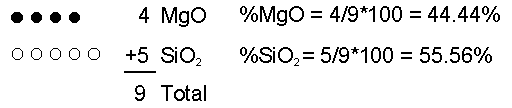
Imagine a liquid containing 5 molecules of MgO and 5 molecules of SiO2. Initially the composition of this magma is expressed as 50% SiO2 and 50% MgO. i.e.

Now let's imagine I remove 1 MgO molecule by putting it into a crystal and removing the crystal from the magma. Now what are the percentages of each molecule in the liquid?
 
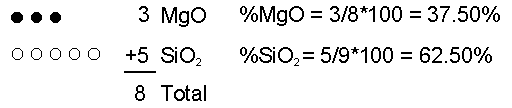
If we continue the process one more time by removing one more MgO molecule

Thus, composition of liquid can be changed.

Bowen's Reaction Series

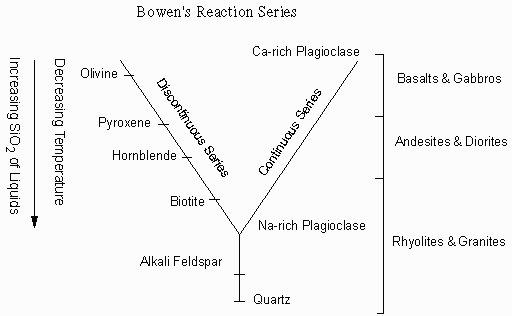
Bowen found by experiment that the order in which minerals crystallize from a basaltic magma depends on temperature.  As a basaltic magma is cooled Olivine and Ca-rich plagioclase crystallize first.  Upon further cooling, Olivine reacts with the liquid to produce pyroxene and Ca-rich plagioclase react with the liquid to produce less Ca-rich plagioclase.  But, if the olivine and Ca-rich plagioclase are removed from the liquid by crystal fractionation, then the remaining liquid will be more SiO2 rich.  If the process continues, an original basaltic magma can change to first an andesite magma then a rhyolite magma with falling temperature


Igneous Environments and Igneous Rocks
The environment in which magma completely solidifies to form a rock determines:
  1. The type of rock
  2. The appearance of the rock as seen in its texture
  3. The type of rock body.
In general there are two environments to consider:
The intrusive or plutonic environment is below the surface of the earth. This environment is characterized by higher temperatures which result in slow cooling of the magma.  Intrusive or plutonic igneous rocks form here.
Where magma erupts on the surface of the earth, temperatures are lower and cooling of the magma takes place much more rapidly.  This is the extrusive or volcanic environment and results in extrusive or volcanic igneous rocks.
Extrusive Environments
When magmas reach the surface of the Earth they erupt from a vent called a volcano.  They may erupt explosively or non-explosively.
  • Non-explosive eruptions are favored by low gas content and low viscosity magmas (basaltic to andesitic magmas and sometimes rhyolitic magma).
    • Usually begin with fire fountains due to release of dissolved gases
    • Produce lava flows on surface
    • Produce Pillow lavas if erupted beneath water

  • Explosive eruptions are favored by high gas content and high viscosity (andesitic to rhyolitic magmas).
    • Expansion of gas bubbles is resisted by high viscosity of magma - results in building of pressure
    • High pressure in gas bubbles causes the bubbles to burst when reaching the low pressure at the Earth's surface.
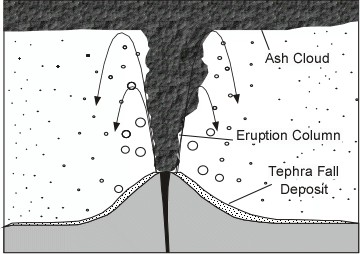
    • Bursting of bubbles fragments the magma into pyroclasts and tephra (ash).
    • Cloud of gas and tephra rises above volcano to produce an eruption column that can rise up to 45 km into the atmosphere.

Tephra that falls from the eruption column produces a tephra fall deposit.EruptColumn.GIF (17691 bytes)
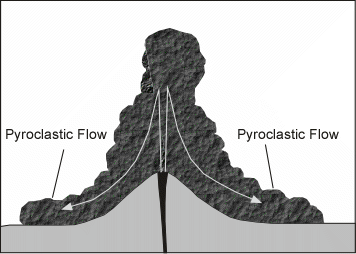
If eruption column collapses a pyroclastic flow may occur, wherein gas and tephra rush down the flanks of the volcano at high speed.  This is the most dangerous type of volcanic eruption.  The deposits that are produced are called ignimbrites.PyroclasFlow.GIF (12927 bytes)
Intrusive Environments
Magma that cools at depth form bodies of rocks called intrusive bodies or plutonic bodies called plutons, from Greek god of the underworld - Pluto. When magma intrudes it usually affects the surrounding rock and is also affected by the surrounding rock.  It may metamorphose the surrounding rocks or cause hydrothermal alteration. The magma itself may also cool rapidly near the contact with the surrounding rock and thus show a chilled margin next to the contact.  
It may also incorporate pieces of the surrounding rocks without melting them.  These incorporated pieces are called xenoliths (foreign rocks).

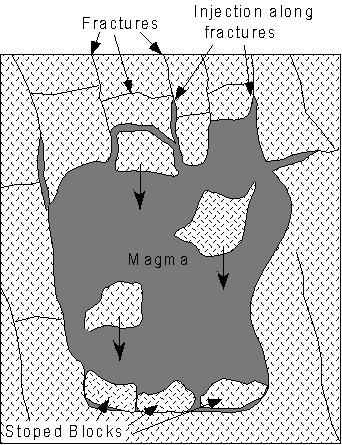
Magma intrudes by injection into fractures in the rock and expanding the fractures.   The may also move by a process called stoping, wherein bocks are loosened by magma at the top of the magma body with these blocks then sinking through the magma to accumulate on the floor of the magma body. 
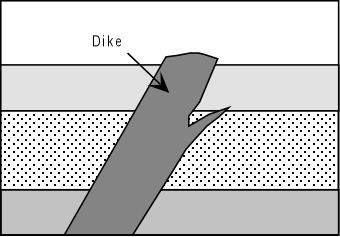
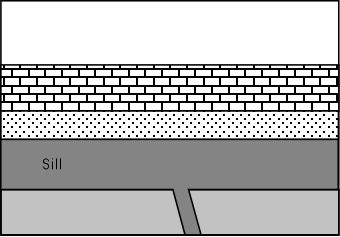
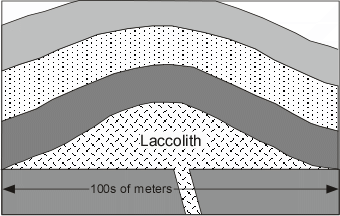
In relatively shallow environments intrusions are usually tabular bodies like dikes and sills or domed roof bodies called laccoliths.
   
  • Dikes are small (<20 m wide) shallow intrusions that show a discordant relationship to the rocks in which they intrude.  Discordant means that they cut across preexisting structures.  They may occur as isolated bodies or may occur as swarms of dikes emanating from a large intrusive body at depth.
dike.gif (5977 bytes)
  • Sills are also small (<50 m thick) shallow intrusions that show a concordant relationship with the rocks that they intrude.  Sills usually are fed by dikes, but these may not be exposed in the field. 
sill.gif (4277 bytes)
  • Laccoliths are somewhat large intrusions that result in uplift and folding of the preexisting rocks above the intrusion.  They are also concordant types of intrusions.
laccolith.gif (9944 bytes)

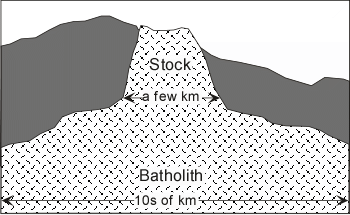
Deeper in the earth intrusion of magma can form bulbous bodies called plutons and the coalescence of many plutons can form much larger bodies called batholiths.
  • Plutons are large intrusive bodies, of any shape that intrude in replace rocks in an irregular fashion. 
  • Stocks are smaller bodies that are likely fed from deeper level batholiths.  Stocks may have been feeders for volcanic eruptions, but because large amounts of erosion are required to expose a stock or batholith, the associated volcanic rocks are rarely exposed.

  • If multiple intrusive events occur in the same part of the crust, the body that forms is called abatholith.  Several large batholiths occur in the western U.S. - The Sierra Nevada Batholith, the Coast Range Batholith, and the Idaho Batholith, for example (See figure 6.10d in your text).
batholith.gif (8597 bytes)

During a magmatic event there is usually a close relationship between intrusive activity and extrusive activity, but one cannot directly observe the intrusive activity.   Only after erosion of the extrusive rocks and other rock above the intrusions has exposed the intrusions do they become visible at the earth's surface (see figure 6.10a in your text).
  
The rate of cooling of magma depends largely on the environment in which the magma cools.   Rapid cooling takes place on the Earth's surface where there is a large temperature contrast between the atmosphere/ground surface and the magma.  Cooling time for material erupted into air and water can be as short as several seconds.   For lava flows cooling times are on the order of days to weeks.   Shallow intrusions cool in months to years and large deep intrusions may take millions of years to cool.

   
Because cooling of the magma takes place at a different rate, the crystals that form and their interrelationship (texture) exhibit different properties.
  • Fast cooling on the surface results in many small crystals or quenching to a glass. Gives rise to aphanitic texture (crystals cannot be distinguished with the naked eye), or obsidian (volcanic glass).
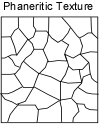
  • Slow cooling at depth in the earth results in fewer much larger crystals, gives rise to phaneritic texture.
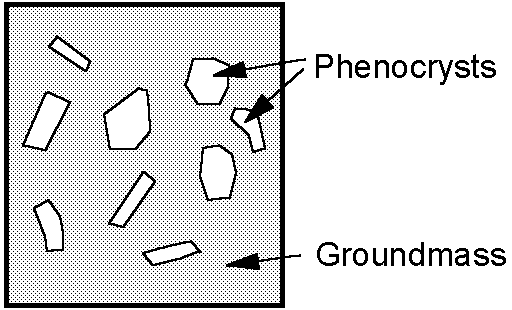
  • Porphyritic texture develops when slow cooling is followed by rapid cooling. Phenocrysts = larger crystals, matrix orgroundmass = smaller crystals.
Classification of Igneous Rocks 

Igneous rocks are classified on the basis of texture and chemical composition, usually as reflected in the minerals that from due to crystallization.   You will explore the classification of igneous rocks in the laboratory portion of this course.

Extrusive/Volcanic Rocks
Basalts, Andesites, and Rhyolites are all types of volcanic rock distinguished on the basis of their mineral assemblage and chemical compostion (see figure 6.13 in your text).  These rocks tend to be fine grained to glassy or porphyritic.  Depending on conditions present during eruption and cooling, any of these rock types may form one of the following types of volcanic rocks.
  • Obsidian - dark colored volcanic glass showing concoidal fracture and few to no crystals. Usually rhyolitic .
  • Pumice - light colored and light weight rock consisting of mostly holes (vesicles) that were once occupied by gas, Usually rhyolitic or andesitic.
  • Vesicular rock - rock filled with holes (like Swiss cheese) or vesicles that were once occupied by gas. Usually basaltic and andesitic.
  • If vesicles in a vesicular basalt are later filled by precipitation of calcite or quartz, the fillings are termed amygdules and the basalt is termed an amygdularl basalt.
  • Pyroclasts = hot, broken fragments. Result from explosively ripping apart of magma. Loose assemblages of pyroclasts called tephra. Depending on size, tephra can be classified as bombs. lapilli, or ash.
  • Rock formed by accumulation and cementation of tephra called a pyroclastic rock or tuff. Welding, compactioncause tephra (loose material) to be converted in pyroclastic rock.


Intrusive/Plutonic Igneous Rocks
Shallow intrusions like dikes and sills are usually fine grained and sometimes porphritic because cooling rates are similar to those of extrusive rocks.   Classification is similar to the classification for volcanic/extrusive rocks.  Coarse grained rocks, formed at deeper levels in the earth include gabbros, diorites, and granites.  Note that these are chemically equivalent to basalts, andesites, and rhyolites, but may have different minerals or different proportions of mineral because their crystallization history is not interrupted as it might be for extrusive rocks (see figure 6.13 in your text).
Pegmatites are very coarse grained igneous rocks consisting mostly of quartz and feldspar as well as some more exotic minerals like tourmaline, lepidolite, muscovite.  These usually form dikes related to granitic plutons.
Distribution of Igneous Activity
Igneous activity is currently taking place as it has in the past in various tectonic settings.   These include diverging and converging plate boundaries, hot spots, and rift valleys.

Divergent Plate Boundaries
At oceanic ridges, igneous activity involves eruption of basaltic lava flows that form pillow lavas at the oceanic ridges and intrusion of dikes and plutons beneath the ridges.   The lava flows and dikes are basaltic and the plutons mainly gabbros.   These processes form the bulk of the oceanic crust as a result of sea floor spreading.  Magmas are generated by decompression melting as hot solid asthenosphere rises and partially melts.
Convergent Plate Boundaries
Subduction at convergent plate boundaries introduces water into the mantle above the subduction and causes flux melting of the mantle to produce basaltic magmas.  These rise toward the surface differentiating by assimilation and crystal fractionation to produce andesitic and rhyolitic magmas.  The magmas that reach the surface build island arcs and continental margin volcanic arcs built of basalt, andesite, and rhyolite lava flows and pyroclastic material.  The magmas that intrude beneath these arcs can cause crustal melting and form plutons and batholiths of diorite and granite

Hot Spots
As discussed previously, hot spots are places are places where hot mantle ascends toward the surface as plumes of hot rock.  Decompression melting in these rising plumes results in the production of magmas which erupt to form a volcano on the surface or sea floor, eventually building a volcanic island.  As the overriding plate moves over the hot spot, the volcano moves off of the hot spot and a new volcano forms over the hot spot.  This produces a hot spot track consisting of lines of extinct volcanoes leading to the active volcano at the hot spot.  A hot spot located beneath a continent can result in heat transfer melting of the continental crust to produce large rhyolitic volcanic centers and plutonic granitic plutons below.   A good example of a continental hot spot is at Yellowstone in the western U.S.  Occasionally a hot spot is coincident with an oceanic ridge.  In such a case, the hot spot produces larger volumes of magma than normally occur at ridge and thus build a volcanic island on the ridge.  Such is the case for Iceland which sits atop the Mid-Atlantic Ridge.
Rift Valleys
Rising mantle beneath a continent can result in extensional fractures in the continental crust to form a rift valley.  As the mantle rises it undergoes partial melting by decompression, resulting in the production of basaltic magmas which may erupt as flood basalts on the surface.   Melts that get trapped in the crust can release heat resulting in melting of the crust to form rhyolitic magmas that can also erupt at the surface in the rift valley.  An excellent example of a continental rift valley is the East African Rift. 
Large Igneous Provinces
In the past, large volumes of mostly basaltic magma have erupted on the sea floor to form large volcanic plateaus, such as the Ontong Java Plateau in the eastern Pacific.   Such large volume eruptions can have affects on the oceans because they change the shape of ocean floor and cause a rise in sea level, that sometimes floods the continents.   The plateaus form obstructions which can drastically change ocean currents. These changes in the ocean along with massive amounts of gas released by the magmas can alter climate and have drastic effects on life on the planet.