Showing posts with label geologic time. Show all posts

Friday, March 3, 2017

Anthropocene

What is anthropocene?

The anthropocene Epoch is atop of the table.
Almost everyone will ask, what is Anthropocene? What is the Anthropocene age or Anthropocene epoch or Anthropocene era? So, here let's start with the definition and learn the ages of man effects on Earth.
The Anthropocene definition, Earth's most recent geologic time period as being human-influenced, or anthropogenic, based on overwhelming global evidence that atmospheric, geologic, hydrologic, biospheric and other earth system processes are now altered by humans.
The word combines the root "anthropo", meaning "human" with the root "-cene", the standard suffix for "epoch" in geologic time.
The Anthropocene is distinguished as a new period either after or within the Holocene epoch, the current epoch, which began approximately 10,000 years ago (about 8000 BC) with the end of the last glacial period.

Epoch definition and Epoch meaning

  1. an event or a time marked by an event that begins a new period or developmentb
  2. memorable event or date
  3. an extended period of time usually characterized by a distinctive development or by a memorable series of eventsb 
  4. division of geologic time less than a period and greater than an age
  5. an instant of time or a date selected as a point of reference (as in astronomy)

From when Anthropocene Epoch Start?

The Anthropocene Epoch should begin about 1950, the experts said, and was likely to be defined by the radioactive elements dispersed across the planet by nuclear bomb tests, although an array of other signals, including plastic pollution, soot from power stations, concrete, and even the bones left by the global proliferation of the domestic chicken were now under consideration.
The current Holocene epoch, is the 12,000 years of stable climate since the last ice age during which all human civilisation developed. But the striking acceleration since Anthropocene timeline, the mid-20th century of carbon dioxide emissions and sea level rise, the global mass extinction of species, and the transformation of land by deforestation and development mark the end of that slice of geological time, the experts argue. The Earth is so profoundly changed that the Holocene must give way to the Anthropocene.

The Anthropocene Review or Anthropocene theory (Debate on current epoch)

The Anthropocene Review or Anthropocene theory, According to the International Union of Geological Sciences (IUGS), the professional organization in charge of defining Earth’s time scale, we are officially in the Holocene epoch (entirely recent), which began 11,700 years ago after the last major ice age.
Holocene and Anthropocene both are geological epoch however, Anthropocene era has become an environmental buzzword ever since the atmospheric chemist and Nobel laureate Paul Crutzen popularised it in 2000. This year, the word has picked up velocity in elite science circles: It appeared in nearly 200 peer-reviewed articles, the publisher Elsevier has launched a new aca­demic journal titled Anthropocene and the IUGS convened a group of scholars to decide by 2016 whether to officially declare that the Holocene is over and the Anthropocene age has begun.
Many stratigraphers (scientists who study rock layers) criticise the idea, saying clear-cut evidence for a new epoch simply isn’t there. “When you start naming geologic-time terms, you need to define what exactly the boundary is, where it appears in the rock strata,” says Whitney Autin, a stratigrapher at the SUNY College of Brockport, who suggests Anthropocene is more about pop culture than hard science. The crucial question, he says, is specifying exactly when human beings began to leave their mark on the planet: The atomic era, for instance, has left traces of radiation in soils around the globe, while deeper down in the rock strata, agriculture’s signature in Europe can be detected as far back as A.D. 900. The Anthropocene, Autin says, “provides eye-catching jargon, but from the geologic side, I need the bare bones facts that fit the code.”

Nature of human effects

Biodiversity

The human impact on biodiversity forms one of the primary attributes of the Anthropoceno. Humankind has entered what is sometimes called the Earth's sixth major extinction. Most experts agree that human activities have accelerated the rate of species extinction. The exact rate remains controversial perhaps 100 to 1000 times the normal background rate of extinction. A 2010 study found that "marine phytoplankton the vast range of tiny algae species accounting for roughly half of Earth's total photosynthetic biomass – had declined substantially in the world's oceans over the past century. From 1950 alone, algal biomass decreased by around 40%, probably in response to ocean warming and that the decline had gathered pace in recent years. Some authors have postulated that without human impacts the biodiversity of the planet would continue to grow at an exponential rate. 
Increases in global rates of extinction have been elevated above background rates since at least 1500, and appear to have accelerated in the 19th century and further since. A 13 July 2012 New York Times op-ed by ecologist Roger Bradbury predicted the end of biodiversity for the oceans, labelling coral reefs doomed: "Coral reefs will be the first, but certainly not the last, major ecosystem to succumb to the Anthropocene." This op-ed quickly generated much discussion among conservationists; The Nature Conservancy rebutted Bradbury on its website, defending its position of protecting coral reefs despite continued human impacts causing reef declines.
In a pair of studies published in 2015, extrapolation from observed extinction of Hawaiian snails led to the conclusion that "the biodiversity crisis is real", and that 7% of all species on Earth may have disappeared already. Human predation was noted as being unique in the history of life on Earth as being a globally distributed 'superpredator', with predation of the adults of other apex predators and with widespread impacts on food webs worldwide.

Biogeography

Permanent changes in the distribution of organisms from human influence will be identifiable in the geologic record. Many species have been documented moving into regions that were once too cold for them, often at rates faster than initially expected. This has occurred in part as a result of evolving climate, but also in response to farming and fishing, and the accidental introduction of non-native species to new areas by global travel. The ecosystem of the entire Black Sea may have changed during the last 2000 years as a result of nutrient and silica input from eroding deforested lands along the Danube River.

Climate

One geological symptom resulting from human activity is increasing atmospheric carbon dioxide (CO2) content. During the glacial–interglacial cycles of the past million years, natural processes have varied CO2 by approximately 100 ppm (from 180 ppm to 280 ppm). As of 2013, anthropogenic net emissions of CO2 increased atmospheric concentration by a comparable amount from 280 ppm (Holocene or pre-industrial "equilibrium") to approximately 400 ppm, with 2015–16 monthly monitoring data of CO2 displaying a rising trend above 400 ppm. This signal in the Earth's climate system is especially significant because it is occurring much faster, and to a greater extent, than previous, similar changes. Most of this increase is due to the combustion of fossil fuels such as coal, oil, and gas, although smaller fractions are the result of cement production and land-use changes (e.g. deforestation).

Geomorphology

Changes in drainage patterns traceable to human activity will persist over geologic time in large parts of the continents where the geologic regime is erosional. This includes the paths of roads and highways defined by their grading and drainage control. Direct changes to the form of the Earth's surface by human activities (e.g., quarrying, landscaping) also record human impacts.

Stratigraphy

Sedimentological record

Human activities like deforestation and road construction are believed to have elevated average total sediment fluxes across the Earth's surface. However, construction of dams on many rivers around the world means the rates of sediment deposition in any given place do not always appear to increase in the Anthropocene. For instance, many river deltas around the world are actually currently starved of sediment by such dams, and are subsiding and failing to keep up with sea level rise, rather than growing.

Fossil record

Increases in erosion due to farming and other operations will be reflected by changes in sediment composition and increases in deposition rates elsewhere. In land areas with a depositional regime, engineered structures will tend to be buried and preserved, along with litter and debris. Litter and debris thrown from boats or carried by rivers and creeks will accumulate in the marine environment, particularly in coastal areas. Such manmade artefacts preserved in stratigraphy are known as "techno-fossils".
Changes in biodiversity will also be reflected in the fossil record, as will species introductions. An example cited is the domestic chicken, originally the red junglefowl Gallus gallus, native to south-east Asia but has since become the world's most common bird through human breeding and consumption, with over 60 billion consumed a year and whose bones would become fossilised in landfill sites.

Trace elements

In terms of trace elements, there are distinct signatures left by modern societies. For example, in the Upper Fremont Glacier in Wyoming, there is a layer of chlorine present in ice cores from 1960s atomic weapon testing programs, as well as a layer of mercury associated with coal plants in the 1980s. From 1945 to 1951, nuclear fallout is found locally around atomic device test sites, whereas from 1952 to 1980, tests of thermonuclear devices have left a clear, global signal of excess 14C, 239Pu, and other artificial radionuclides. The highest concentration of radionuclides was in 1964, one of the dates which has been proposed as a possible benchmark for the start of the formally defined age of Anthropocene.
Human burning of fossil fuels has also left distinctly elevated concentrations of black carbon, inorganic ash, and spherical carbonaceous particles in recent sediments across the world. Concentrations of these components increases markedly and almost simultaneously around the world beginning around 1950.

Friday, February 3, 2017

The Messinian Salinity Crisis


You will have heard of The Messinian Salinity Crisis no doubt. From learned articles, geology textbooks, probably lectures at your college or University. Or possibly not. This was not always the hot topic it is now. In fact, the very idea of this happening, was for a while, challenged, even ridiculed. It seemed too incredible that this could happen as it did and Dessication/Flood theories took time to gain traction. But, if you had heard about it, you would remember that The Messinian Salinity Crisis, was a time when the Mediterranean Sea, very much as we know it today, evaporated – dried out, almost completely.


You will have heard of the rates of desiccation, influx and yet more desiccation, repeated in endless cycles over tens, even hundreds of thousands of years. On a human temporal scale, this would have been a long drawn out affair, covering a time hundreds of generations deep, more than the span of Homo sapiens existence. In Geologic terms however, it was a string of sudden events. Of incredibly hot and arid periods followed by rapid ingress of waters, either via spillways through what is now modern day Morocco and the southern Iberian peninsular, or headlong through a breach in the sill between the Pillars of Heracles, the modern day Straights of Gibraltar.

There were prolonged periods of dessication, of desolate landscapes beyond anything seen today in Death Valley or The Afar Triangle. These landscapes were repeatedly transgressed by brackish waters from storm seasons far into the African and Eurasian interiors, or the Atlantic, and these in turn dried out. Again and again this happened. It had to be so because the vast deposits of rock salt, gypsum and anhydrites could not have been emplaced in a single evaporite event. The salt deposits in and around the Mediteranean today represent fifty times the current capacity of this great inland sea. You may have heard too of the variety of salts production, as agglomerating crystals fell from the descending surface to the sea floor, or as vast interconnected hypersaline lakes left crystalline residues at their diminishing margins, as forsaken remnant sabkhas, cut off from the larger basins, left behind acrid dry muds of potassium carbonates – the final arid mineral residue of the vanished waters.

Just under six million years ago, Geologic processes isolated what was left of the ancient Tethys ocean, the sea we know as the Mediterranean, home to historic human conflicts and marine crusades of Carthage, Rome, Athens and Alexandria, a Sea fringed by modern day Benidorm, Cyprus, Malta and Monaco. At a time 5.96 million years ago – evaporation outpaced replenishment. Indeed, just as it does today, but without the connecting seaway to replenish losses. Inexorable tectonic activity first diverted channels, then – sealed them. Cut off from the Atlantic in the West, water levels fell, rose briefly and fell again, and again. The mighty Nile - a very different geophysical feature of a greater capacity than today, and the rivers of Europe cut down great canyons hundreds and thousands of metres below present Eustatic sea and land surface levels, as seismic cross sections show in staggering detail. The cores taken at depth in the Mediterranean, show Aeolian sands above layers of salt, fossiliferous strata beneath those same salts, all indicating changing environments. The periods of blackened unshifting desert varnished floors and bleached playas, decades and centuries long, were punctuated often by catastrophic episodes, with eroded non conformable surfaces of winnowed desert pavement, toppled ventifracts, scours and rip up clasts. Species of fossilised terrestrial plant life, scraping an arid existence have been found, thousands of meters down, in the strata of the Mediterranean sea floor.


There is much evidence too, in the uplifted margins of Spain, France, and Sicily, of those hostile millennia when the sea disappeared. Incontrovertible evidence, painstakingly gathered, analysed and peer reviewed, demonstrates via the resources of statistical analysis, calculus and geophysical data that the Messinian Salinity Crisis was a period during the Miocene wherein the geology records a uniquely arid period of repeated partial and very nearly complete desiccation of the Mediterranean Sea over a period of approximately 630,000 years. But for the Geologist, the story doesn’t end there. The Geologists panoptic, all seeing third eye, sees incredible vistas and vast panoramas. Of a descent from the Alpine Foreland to the modern day enclave of Monaco, gazing out southwards from a barren, uninhabited and abandoned raised coast to deep dry abyssal plains, punctuated by exposed chasms, seamounts and ridges, swirling and shifting so slowly in a distant heat haze. A heat haze produced by temperatures far above any recorded by modern man and his preoccupation with Global Warming. An unimaginable heat sink would produce temperatures of 70 to 80 degrees Celsius at 4000M depth within the basins. 


Looking down upon this Venusian landscape, the sun might glint on remaining lakes and salt flats so very far away and so very much farther below. Hills and valleys, once submerged, would be observed high and dry – from above, as would the interconnecting rivers of bitter waters hot enough to slowly broil any organism larger than extremophile foraminifer. All this, constantly shimmering in the relentless heat. Only the imagination of the geologist could see the vast, hellish, yet breathtaking landscape conjured up by the data and the rock record. And finally, the Geologist would visualise a phenomenon far greater in scope and magnitude than any Biblical flood – The Zanclean Event.
Also known as The Zanclean Deluge, when the drought lasting over half a million years was finally ended as the Atlantic Ocean breached the sill/land bridge between Gibraltar and North West Africa. Slowly perhaps at first until a flow a thousand times greater than the volumetric output of the Amazon cascaded down the slopes to the parched basins. Proximal to the breach, there would be a deafening thunderous roar and the ground would tremor constantly, initially triggering great avalanches above and below the Eustatic sea level as the far reaching and continuous concussion roared and rumbled on, and on, and on. For centuries great cataracts and torrents of marine waters fell thousands of metres below and flowed thousands of kilometers across to the East. Across to the abyssal plains off the Balearics, to the deeps of the Tyrrhenian and Ionian seas, into the trenches south of the Greek Islands and finally up to the rising shores of The Lebanon. The newly proximal waters to the final coastal reaches and mountains that became islands, must have had a climatological effect around the margins of the rejuvenated Mediterranean. Flora and Fauna both marine and terrestrial will have recolonised quickly. Species may have developed differently, post Zanclean, on the Islands. And in such a short period, there must surely have been earthquakes and complex regional depression and emergence. Isostacy compensated for the trillions of cubic meters of transgression waters that now occupied the great basins between the African and Eurasian plates, moving the land, reactivating ancient faults and within and marginal to the great inland sea, a region long active with convergent movements of a very different mechanism.
Hollywood and Pinewood have yet to match the imagination of the Earth Scientist, of the many chapters of Earths dynamic history held as fully tangible concepts to the men and women who study the rocks and the stories they tell. The movies played out in the mind of the geologist are epic indeed and – as we rightly consider the spectre of Global Warming, consider too the fate of future populations (of whatever evolved species) at the margins of the Mediterranean and the domino regions beyond, when inexorable geologic processes again isolate that benign, sunny holiday sea. Fortunately, not in our lifetime, but that of our far off descendants who will look and hopefully behave very differently from Homo Sapiens.

Note: This blog is written and contributed by Paul Goodrich. You can also contribute your blog or article on our website. See guidelines here.

Saturday, January 28, 2017

Banded-iron formations (BIFs) - Evidence of Oxygen in Early Atmosphere

Our knowledge about the rise of oxygen gas in Earth’s atmosphere comes from multiple lines of evidence in the rock record, including the age and distribution of banded iron formations, the presence of microfossils in oceanic rocks, and the isotopes of sulfur.
However, this article is just focus on Banded Iron Formation.

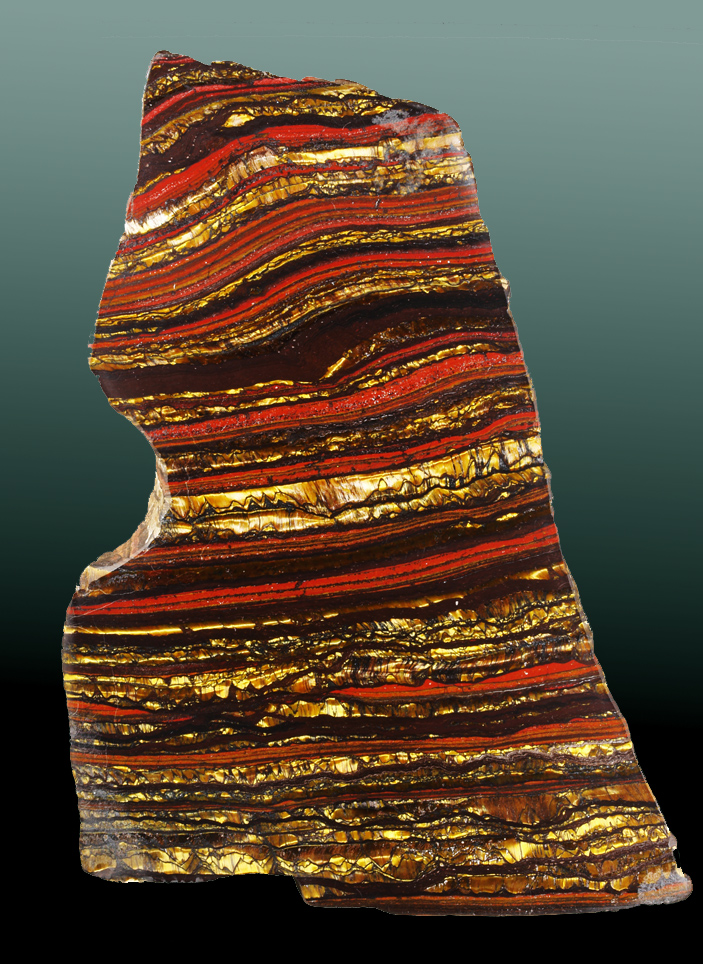
BIF (polished) from Hamersley Iron Formation, West Australia, Australia

Summary: Banded-iron formations (BIFs) are sedimentary mineral deposits consisting of alternating beds of iron-rich minerals (mostly hematite) and silica-rich layers (chert or quartz) formed about 3.0 to 1.8 billion years ago. Theory suggests BIFs are associated with the capture of oxygen released by photosynthetic processes by iron dissolved in ancient ocean water. Once nearly all the free iron was consumed in seawater, oxygen could gradually accumulate in the atmosphere, allowing an ozone layer to form. BIF deposits are extensive in many locations, occurring as deposits, hundreds to thousands of feet thick. During Precambrian time, BIF deposits probably extensively covered large parts of the global ocean basins. The BIFs we see today are only remnants of what were probably every extensive deposits. BIFs are the major source of the world's iron ore and are found preserved on all major continental shield regions. 

Banded-iron formation (BIF)
is 
consists of layers of iron oxides (typically either magnetite or hematite) separated by layers of chert (silica-rich sedimentary rock). Each layer is usually narrow (millimeters to few centimeters). The rock has a distinctively banded appearance because of differently colored lighter silica- and darker iron-rich layers. In some cases BIFs may contain siderite (carbonate iron-bearing mineral) or pyrite (sulfide) in place of iron oxides and instead of chert the rock may contain carbonaceous (rich in organic matter) shale.

It is a chemogenic sedimentary rock (material is believed to be chemically precipitated on the seafloor). Because of old age BIFs generally have been metamorphosed to a various degrees (especially older types), but the rock has largely retained its original appearance because its constituent minerals are fairly stable at higher temperatures and pressures. These rocks can be described as metasedimentary chemogenic rocks.


                     Jaspilite banded iron formation (Soudan Iron-Formation, Soudan, Minnesota, USA
Image Credits: James St. John


In the 1960s, Preston Cloud, a geology professor at the University of California, Santa Barbara, became interested in a particular kind of rock known as a Banded Iron Formation (or BIF). They provide an important source of iron for making automobiles, and provide evidence for the lack of oxygen gas on the early Earth.

Cloud realized that the widespread occurrence of BIFs meant that
the conditions needed to form them must have been common on the ancient Earth, and not common after 1.8 billion years ago. Shale and chert often form in ocean environments today, where sediments and silica-shelled microorganisms accumulate gradually on the seafloor and eventually turn into rock. But iron is less common in younger oceanic sedimentary rocks. This is partly because there are only a few sources of iron available to the ocean: isolated volcanic vents in the deep ocean and material weathered from continental rocks and carried to sea by rivers.


Banded iron-formation (10 cm), Northern Cape, South Africa.
Specimen and photograph: A. Fraser
Most importantly, it is difficult to transport iron very far from these sources today because when iron reacts with oxygen gas, it becomes insoluble (it cannot be dissolved in water) and forms a solidparticle. Cloud understood that for large deposits of iron to exist all over the world’s oceans, the iron must have existed in a dissolved form. This way, it could be transported long distances in seawater from its sources to the locations where BIFs formed. This would be possible only if there were little or no oxygen gas in the atmosphere and ocean at the time the BIFs were being deposited. Cloud recognized that since BIFs could not form in the presence of oxygen, the end of BIF deposition probably marked the first occurrence of abundant oxygen gas on Earth (Cloud, 1968).
Cloud further reasoned that, for dissolved iron to finally precipitate and be deposited, the iron would have had to react with small amounts of oxygen near the deposits. Small amounts of oxygen could have been produced by the first photosynthetic bacteria living in the open ocean. When the dissolved iron encountered the oxygen produced by the photosynthesizing bacteria, the iron would have precipitated out of seawater in the form of minerals that make up the iron-rich layers of BIFs: hematite (Fe2O3) and magnetite (Fe3O4), according to the following reactions:
4Fe3 + 2O2 → 2Fe2O3
6Fe2 + 4O2 → 2Fe3O4
The picture that emerged from Cloud’s studies of BIFs was that small amounts of oxygen gas, produced by photosynthesis, allowed BIFs to begin forming more than 3 billion years ago. The abrupt disappearance of BIFs around 1.8 billion years ago probably marked the time when oxygen gas became too abundant to allow dissolved iron to be transported in the oceans.
Banded Iron Formation
Source is unknown

It is interesting to note that BIFs reappeared briefly in a few places around 700 millionyears ago,during a period of extreme glaciation when evidence suggests that Earth’s oceans were entirely covered with sea ice. This would have essentially prevented the oceans from interacting with the atmosphere, limiting the supply of oxygen gas in the water and again allowing dissolved iron to be transported throughout the oceans. When the sea ice melted, the presence of oxygen would have again allowed the iron to precipitate.

References:

1. Misra, K. (1999). Understanding Mineral Deposits Springer.
2. 
Cloud, P. E. (1968). Atmospheric and hydrospheric evolution on the primitive Earth both secular accretion and biological and geochemical processes have affected Earth’s volatile envelope. Science, 160(3829), 729–736.
3. 
James,H.L. (1983). Distribution of banded iron-formation in space and time. Developments in Precambrian Geology, 6, 471–490.

Tuesday, December 27, 2016

10 of the Best Learning Geology Photos of 2016

A picture is worth a thousand words, but not all pictures are created equal. The pictures we usually feature on Learning Geology are field pictures showing Geological structures and features and many of them are high quality gem and mineral pictures. The purpose is to encourage students and professionals' activities by promoting "learning and scope" of Geology through our blogs.
In the end of 2016, we are sharing with you the 10 best photos of 2016 which we have posted on our page.

P.S: we always try our best to credit each and every photographer or website, but sometimes it’s impossible to track some of them. Please leave a comment if you know about the missing ones.

1. Folds from Basque France

 Image Credits: Yaqub ShahYaqub Shah

2. Horst and Graben Structure in Zanjan, Iran


Image Credits: https://www.instagram.com/amazhda


3. A unique Normal Fault

4. The Rock Cycle
The
 rock cycle illustrates the formation, alteration, destruction, and reformation of earth materials, and typically over long periods of geologic time. The rock cycle portrays the collective system of processes, and the resulting products that form, at or below the earth surface.The illustration below illustrates the rock cycle with the common names of rocks, minerals, and sediments associated with each group of earth materials: sediments, sedimentary rocks, metamorphic rocks, and igneous rocks.


Image Credits: Phil Stoffer


5. An amazing Botryoidal specimen for Goethite lovers! 


Image Credits: Moha Mezane 
   

6. Basalt outcrop of the Semail Ophiolite, Wadi Jizzi, Oman

Image Credits: Christopher Spencer
Christopher Spencer is founder of an amazing science outreach program named as Traveling Geologist. Visit his website to learn from him


7. Val Gardena Dolomites, Northern Italy


8. Beautiful fern fossil found in Potsville Formation from Pennsylvania.
The ferns most commonly found are Alethopteris, Neuropteris, Pecopteris, and Sphenophyllum.


Image Credits: Kurt Jaccoud


9. Snowball garnet in schist

Syn-kinematic crystals in which “Snowball garnet” with highly rotated spiral Si. 

Porphyroblast is ~ 5 mm in diameter.
From Yardley et al. (1990) Atlas of Metamorphic Rocks and their Textures.


10. Trilobite Specimen from Wheeler Formation, Utah
The Wheeler Shale is of Cambrian age and is a world famous locality for prolific trilobite remains. 


Image Credits: Paleo Fossils